
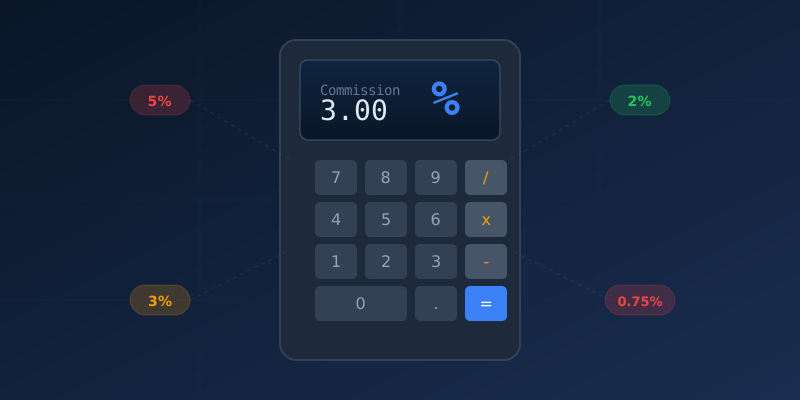
Compare Exchange Commission Rates and Cut Your Betting Costs
Commission is the price you pay for using a betting exchange. It sounds simple, but the real cost of exchange betting extends far beyond the headline percentage. Between base commission, discount tiers, Expert Fee charges, spread costs, and liquidity differences, two platforms quoting similar rates can cost you vastly different amounts over a year. This comparison breaks down every major exchange and broker platform with real EUR calculations so you can see exactly what you are paying and where you could be saving.
Why Commission Matters More Than You Think
Many bettors treat commission as a background cost. They focus on finding winning selections and assume the commission will take care of itself. This is a mistake that costs serious money over time.
Consider a bettor generating EUR 8,000 in gross annual profit on exchanges. At 5% commission (Betfair standard), they pay EUR 400. At 2% (Smarkets), they pay EUR 160. At 3% (broker exchange), they pay EUR 240. The difference between the most and least expensive option is EUR 240 per year. That alone is worth optimising.
But the real gap appears when the Expert Fee enters the equation. The same bettor on Betfair, once they qualify for the 20% Expert Fee tier, pays an additional EUR 1,520 on top of the base commission, bringing total annual costs to EUR 1,920. Compared to EUR 240 on a broker exchange, the difference is EUR 1,680 per year. Over five years, that is EUR 8,400 in additional costs for the same betting activity on the same liquidity pool. This is not a rounding error. It is a structural disadvantage that compounds every year you remain on the more expensive platform.
Understanding the full cost picture across all available platforms is the first step toward fixing this. Let us start with the headline comparison.
Exchange Commission Rates: Side-by-Side Comparison
| Platform | Base Commission | Discount Tiers | Expert Fee / Premium | Liquidity Source |
|---|---|---|---|---|
| Betfair Exchange | 5% | Yes (down to 2% at highest volume) | 20-60% on qualifying accounts | Own pool (largest globally) |
| Smarkets | 2% | No | None | Own pool (growing, strong on football) |
| Matchbook | 0.75% maker / 1.5% taker | No | None | Own pool (niche, best on US sports) |
| Betdaq | 2% | Negotiable at high volume | None | Own pool (limited outside horse racing) |
| OrbitX (via AsianConnect) | ~3% | Negotiable | None | White-label Betfair liquidity |
| SharpXchange (via BetInAsia) | ~3% | Negotiable at volume | None | White-label Betfair liquidity |
| FairExchange (via MadMarket) | ~3% | No | None | White-label Betfair liquidity |
| PRO (via SportMarket) | ~3% | Negotiable | None | White-label Betfair liquidity |
The table reveals an important pattern. The platforms with the lowest headline commission (Matchbook, Smarkets) operate their own liquidity pools, which are significantly smaller than Betfair's. The broker exchange tools charge slightly more (around 3%) but access Betfair's liquidity pool without the Expert Fee. For bettors who will never trigger the Expert Fee, the cheapest options are Smarkets and Matchbook. For anyone generating consistent profit, broker exchanges represent the best value when total cost is considered.
Betfair: The Full Cost Picture
Betfair dominates exchange betting by liquidity, but its cost structure is the most complex and potentially the most expensive of any platform. Understanding it fully is essential for any serious bettor.
Base Commission
Standard rate: 5% on net market winnings. This means if you win EUR 100 on a market, you pay EUR 5. If you lose on a market, you pay nothing. Commission is calculated per market, not per bet, so if you have multiple bets on the same market, your wins and losses are netted before commission applies.
Discount Tiers
Betfair offers a points-based discount system. You earn Betfair Points based on your commission generated, and these points determine your discount tier. At the highest tiers (available to extremely high-volume users), commission can drop to 2%. In practice, most regular bettors settle between 3.5% and 5%. The discount is meaningful for high-volume users but requires substantial and sustained activity to maintain.
The Expert Fee
This is where Betfair's cost structure becomes punitive for winning players. The Expert Fee (rebranded from Premium Charge) applies when your account meets specific criteria related to profitability, activity period, and the ratio of winnings to charges. The charge ranges from 20% to as high as 60% of your gross weekly profit and is applied after standard commission.
Example: How the Expert Fee Erodes Profit
You generate EUR 500 in gross exchange profit in a week. Standard 5% commission: EUR 25. You now have EUR 475. The 20% Expert Fee applies to your gross profit: EUR 100. Your net profit for the week: EUR 375. Without the Expert Fee, you would have kept EUR 475. The Expert Fee took 21% of your after-commission profit. At the 40% tier, the fee would be EUR 200, leaving you with just EUR 275 from a EUR 500 gross week. These percentages apply every week, every month, every year. There is no cap and no exit once you qualify.
Smarkets, Matchbook and Betdaq: The Independent Alternatives
Smarkets: 2% Flat Commission
Smarkets has positioned itself as the low-cost Betfair alternative with a simple, transparent rate. At 2%, it is 60% cheaper than Betfair's base rate with no hidden charges and no Expert Fee. The interface is clean, the mobile app is solid, and liquidity on major football markets and UK/Irish horse racing is sufficient for most bettors.
The limitation is depth. On a Premier League match, Smarkets might have EUR 50,000-100,000 matched versus EUR 500,000+ on Betfair. For stakes under EUR 500, this rarely matters. For larger positions or less popular markets, you may struggle to get matched at the price you want. Irish racing at smaller tracks (Kilbeggan, Sligo, Downpatrick) typically has thin Smarkets liquidity.
Matchbook: Maker/Taker Model
Matchbook uses a different commission structure. If you place an order that sits in the book waiting to be matched (maker), you pay 0.75%. If you take an existing price (taker), you pay 1.5%. This rewards patient bettors who set their own prices. For active traders who work the order book rather than taking available prices, Matchbook can be the cheapest platform available.
Liquidity is the constraint. Matchbook's strongest markets are American football, basketball, and tennis. On European football and horse racing, the pool is smaller than both Betfair and Smarkets. If your betting is focused on US sports, Matchbook is worth serious consideration. For predominantly Irish and UK markets, it serves best as a secondary platform.
Betdaq: 2% with Limited Scope
Betdaq charges 2% and has operated for over twenty years. Its liquidity is concentrated on UK and Irish horse racing, where it maintains a loyal user base. On football and other sports, available money is sparse. For bettors who focus exclusively on racing, Betdaq offers competitive commission with adequate depth on major meetings. For anyone needing broader market coverage, it is too limited as a primary platform.
Broker Exchange Platforms: Betfair Liquidity Without Betfair Costs
This is where the comparison becomes most interesting for profitable bettors. Broker exchange tools (OrbitX, SharpXchange, FairExchange, PRO) are white-label products that connect to Betfair's liquidity pool. You see the same odds, the same market depth, and the same matched amounts as a direct Betfair user. The difference is in what you pay.
At approximately 3% commission with no Expert Fee, broker exchanges sit in a sweet spot. They cost more than Smarkets or Matchbook on headline rate, but they provide Betfair-grade liquidity. For any bettor generating consistent profit, the absence of the Expert Fee makes them significantly cheaper than Betfair over time. And because the liquidity is shared with Betfair, you do not face the depth limitations of the independent exchanges.
The practical differences between broker exchange tools are minor. OrbitX (via AsianConnect) has the most polished interface and widest feature set. SharpXchange (via BetInAsia ↗) integrates tightly with BetInAsia's Asian bookmaker offerings. FairExchange (via MadMarket) prioritises simplicity. PRO (via SportMarket) combines exchange and bookmaker views for professionals. All four access the same underlying Betfair pool, so the exchange experience is functionally identical across them. Your choice should be driven by which broker's overall package best fits your needs.
Total Cost of Ownership: The Number That Actually Matters
Headline commission is only one component of your total cost. The full picture includes four elements: commission rate, Expert Fee (if applicable), spread cost (the gap between back and lay prices), and liquidity cost (the price impact of placing large orders). Here is how they combine for a realistic Irish bettor.
Example: Annual Cost on EUR 50,000 Turnover
Profile: 500 bets per year, EUR 100 average stake. Strike rate 45% on average odds of 2.50. Gross annual profit: EUR 6,250.
Betfair (5% + Expert Fee 20%): Commission on net winnings: EUR 313. Expert Fee on gross profit: EUR 1,250. Spread cost (estimated 1.5% on turnover): EUR 750. Total: EUR 2,313. Net profit: EUR 3,937.
Smarkets (2%, no Expert Fee): Commission: EUR 125. Spread cost (estimated 2.0% on turnover due to thinner liquidity): EUR 1,000. Total: EUR 1,125. Net profit: EUR 5,125.
Broker exchange at 3% (no Expert Fee): Commission: EUR 188. Spread cost (same as Betfair, shared liquidity pool): EUR 750. Total: EUR 938. Net profit: EUR 5,312.
Matchbook (1.5% taker): Commission: EUR 94. Spread cost (estimated 2.5% on turnover): EUR 1,250. Total: EUR 1,344. Net profit: EUR 4,906.
The broker exchange route is cheapest despite a higher commission rate than Smarkets or Matchbook, because Betfair liquidity means tighter spreads. The annual saving versus direct Betfair is EUR 1,375. Over three years: EUR 4,125.
The hierarchy shifts depending on your profile. If you are a recreational bettor who will never trigger the Expert Fee, Smarkets is the cheapest option for popular markets. If you are a consistent winner, broker exchanges win on total cost. If you are a patient trader who works the order book on US sports, Matchbook's maker rate is compelling. The key insight is that no single platform is cheapest for everyone. Your optimal choice depends on your profitability level, betting volume, and market focus.
Expert Tip
The hidden cost most bettors completely ignore is the spread. The gap between the back and lay price on an exchange represents a cost you pay every time you take a price. On a highly liquid market (say, Match Odds on a Champions League game), the spread might be one tick: 2.02 to back, 2.04 to lay. That is a 1% cost. On a low-liquidity market (a League of Ireland midweek match), the spread might be 2.10 to back, 2.30 to lay. That is a 9.5% cost, which is worse than most bookmaker margins. Before chasing the lowest commission platform, check whether that platform actually has enough liquidity on your markets to provide tight spreads. A 2% commission on a 5% spread costs you 7%. A 3% commission on a 1% spread costs you 4%. The commission is visible. The spread is not. Track both.
Frequently Asked Questions
What is the lowest commission betting exchange?
In terms of headline rate, Matchbook offers the lowest at 0.75% for makers (those who place orders waiting to be matched) and 1.5% for takers. Smarkets charges a flat 2%. However, headline commission is only part of the story. You must also factor in liquidity costs (wider spreads on lower-liquidity platforms cost you more than the commission difference saves) and any premium charges for profitable accounts. When total cost of ownership is calculated, broker exchange tools at around 3% with no Expert Fee often work out cheaper than Betfair at 5% base plus potential Expert Fee.
How does the Betfair Expert Fee work?
The Expert Fee (formerly premium charge) applies to Betfair accounts that meet three criteria: you have been active for a minimum period, your lifetime net winnings are positive, and your ratio of winnings to total charges paid is above a threshold. The charge ranges from 20% to 60% of your gross profits, applied on top of standard commission. It effectively punishes winning players. The fee is calculated weekly, and once you qualify, it is very difficult to escape. Most professional Betfair users eventually encounter it, which is a primary driver of migration to broker exchange platforms.
Is Smarkets better than Betfair for casual bettors?
For casual bettors who will never trigger the Expert Fee, Smarkets offers a clear advantage on commission (2% vs 5%). The trade-off is liquidity. On Premier League football and major horse racing, Smarkets liquidity is adequate. On niche markets (lower leagues, greyhounds, minor racing), Betfair has significantly more money available, which means tighter spreads and better prices. If your betting is concentrated on popular markets, Smarkets saves you money. If you bet across a wide range of markets, Betfair's deeper liquidity may offset the commission difference.
Do broker exchange platforms share Betfair liquidity?
Most broker exchange tools (OrbitX, SharpXchange, FairExchange) access Betfair liquidity through white-label arrangements. This means you see the same market depth and odds as Betfair users, but through a different interface and at a different commission rate. Your bets are matched against the same pool of orders. The practical benefit is significant: you get Betfair-level liquidity without Betfair commission rates or Expert Fee exposure.