
Understand How Betting Exchanges Work and Why They Matter
A betting exchange is a marketplace where bettors trade directly with each other instead of betting against a bookmaker. If you have been betting for any length of time and suspect that traditional bookmaker margins are eating into your returns, understanding how exchanges work is the single most important step you can take toward improving your long-term profitability.
The Exchange Concept: Peer-to-Peer Betting
When you place a bet with a bookmaker, you are betting against the house. The bookmaker sets the odds, builds in a margin (the overround), and pays you if your selection wins. Their profit comes from the gap between true probability and the odds they offer. Over time, this margin guarantees the bookmaker earns money regardless of individual results.
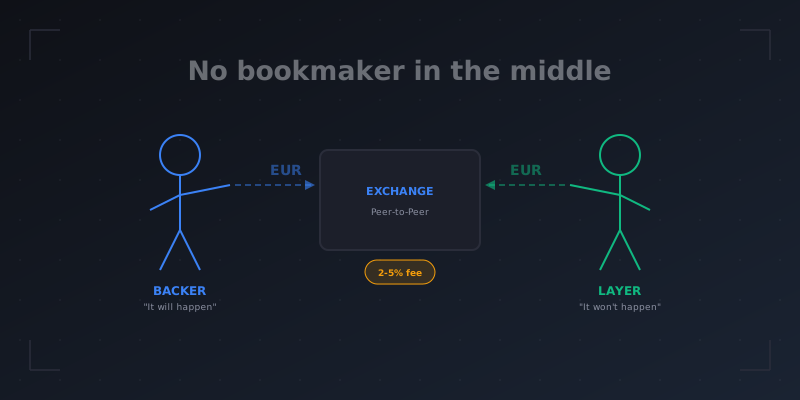
An exchange removes the bookmaker entirely. Instead, two bettors take opposite sides of the same event. One person backs an outcome (believes it will happen), while another lays it (believes it will not). The exchange platform simply matches these two parties, holds the funds in escrow, and settles the market after the event. In return, the exchange takes a commission on the winner's net profit.
This is not a minor structural difference. It fundamentally changes the pricing mechanism. On a bookmaker site, odds are set by a trading team whose job is to ensure the book is profitable. On an exchange, odds are set by the aggregate actions of thousands of bettors, each expressing their own assessment of probability. The result is prices that more closely reflect true market probability, with tighter margins and better value for informed bettors.
Consider a Premier League match where both teams are evenly matched. A bookmaker might offer 2.80 on each side, building in a combined margin of around 7%. On an exchange, you might find 3.00 available on both sides, with the exchange taking 2-5% commission on your profit only if you win. The difference in expected value is substantial over hundreds of bets.
Back and Lay: The Two Sides of Every Exchange Bet
Every exchange market has two columns: the back price (blue) and the lay price (pink). Backing works exactly like placing a traditional bet. You stake a certain amount and receive a payout if your selection wins. Laying is the mirror image. When you lay an outcome, you are effectively acting as the bookmaker for that selection. You accept someone else's stake and pay them if the outcome occurs, keeping their stake if it does not.
| Action | You believe | You risk | You win |
|---|---|---|---|
| Back | The outcome will happen | Your stake (e.g. EUR 100) | Stake x (Odds - 1), e.g. EUR 200 at odds 3.00 |
| Lay | The outcome will not happen | Liability: Stake x (Odds - 1), e.g. EUR 200 | The backer's stake, e.g. EUR 100 |
The ability to lay is what separates exchange betting from everything else. With a bookmaker, you can only back outcomes. On an exchange, you can oppose any selection. This opens up strategies that are simply impossible elsewhere: lay betting, trading positions in-play, hedging existing bets, and locking in profit before an event finishes. For experienced bettors, the lay side of the market is often where the real edge lives.
A practical example: you back a horse at 6.00 for EUR 50 (potential profit EUR 250). The horse shortens to 3.00 in the market before the race. You can now lay the same horse at 3.00 for EUR 100, guaranteeing a profit regardless of the result. This kind of position management is the bread and butter of exchange trading and requires no opinion on the final outcome, only on how the price will move.
How Odds Are Formed: The Exchange Order Book
An exchange operates much like a financial trading venue. Each market has an order book showing the best available back and lay prices along with the amount of money waiting at each price level. When someone wants to back at a price that matches an existing lay offer (or vice versa), the bet is matched instantly. If no matching offer exists, the bet sits in the order book as an unmatched offer until someone takes the other side.
This is worth understanding because it affects how you place bets. On a bookmaker site, you click a price and your bet is accepted instantly at that price (unless it moves during placement). On an exchange, you can either take the best available price for immediate matching, or request a better price and wait in the queue. Requesting a better price is like placing a limit order in stock trading. You might get matched if the market moves your way, or you might not get matched at all.
For sharp bettors, the order book contains valuable information beyond just the current best price. The depth of money at each level tells you how much conviction the market has at various prices. A thin order book (small amounts at each level) suggests the price could move sharply with a single large bet. A deep order book indicates strong consensus. Learning to read order book depth is a skill that separates casual exchange users from profitable traders.
One detail that catches newcomers off guard is the spread between back and lay prices. On liquid markets like a Saturday 3pm Premier League kick-off, the spread might be just one tick (e.g. back 2.98, lay 3.00). On a mid-week League of Ireland match, the spread could be several ticks wide with thin liquidity. The tighter the spread, the cheaper it is to trade in and out of positions. This is why most professional exchange traders focus on high-liquidity markets.
The Commission Model: How Exchanges Earn Money
Exchanges charge commission on your net winnings in each market. The standard Betfair rate is 5%, though this can drop to as low as 2% through their discount rate system based on activity levels. Smarkets charges 2%. Matchbook sits between 0.75% and 1.5%. Broker-accessed platforms like OrbitX and SharpXchange typically charge between 2% and 3%, varying by agreement.
Example: How Commission Affects Your Returns
You back a selection at 4.00 for EUR 200 and it wins. Your gross profit is EUR 600. At Betfair's standard 5% commission, you pay EUR 30 in commission and keep EUR 570. On a broker platform at 2% commission, you pay EUR 12 and keep EUR 588. Over a year of 500 winning bets with an average gross profit of EUR 150, that difference is EUR 22,500 versus EUR 9,000 in commission. The EUR 13,500 gap goes straight to your bottom line.
Commission only applies when you net positive on a market. If you lose, you owe nothing beyond your stake. This is a crucial distinction from bookmaker margins, which are baked into every price whether you win or lose. On an exchange, you are only taxed on success, which makes the effective cost lower than it appears when compared to bookmaker overrounds.
There is a secondary layer to be aware of on Betfair specifically. The Expert Fee applies to lifetime net winners whose profits exceed certain thresholds. At the highest tier, you can lose up to 60% of gross profits on top of standard commission. This charge does not exist on broker-accessed platforms because your bets are placed through the broker's institutional account. For a detailed breakdown of rates across all platforms, see our commission comparison guide.
Liquidity: The Lifeblood of Exchange Betting
Liquidity is the total volume of money available to be matched at current prices. It is the single most important factor determining whether an exchange is usable for serious betting. A market with EUR 500,000 matched allows you to place substantial bets without distorting the price. A market with EUR 2,000 matched means your EUR 500 back bet might only partially match, or it might shift the price against you.
Betfair dominates exchange liquidity globally. UK and Irish horse racing markets regularly see seven-figure matched volumes per race. Premier League and Champions League football markets can exceed EUR 10 million matched. This liquidity is the reason white-label platforms like OrbitX (via AsianConnect) and SharpXchange (via BetInAsia ↗) are so valuable. They tap into Betfair's liquidity pool, giving you the same depth of market without a direct Betfair account.
Where liquidity thins out, you need to adjust your approach. Smaller football leagues, niche sports, and markets more than 48 hours before kick-off typically have lower liquidity. Professional exchange bettors either avoid these markets or use them opportunistically, posting offers at favourable prices and waiting for the market to come to them. Some of the best value on exchanges exists in low-liquidity windows before the market fully forms, but this requires patience and a clear sense of fair value.
Exchange vs Bookmaker: A Direct Comparison
| Feature | Betting Exchange | Traditional Bookmaker |
|---|---|---|
| Odds set by | Market supply and demand | Bookmaker trading team |
| Margin / cost | 1-3% effective (commission on wins) | 5-15% built into every price |
| Lay betting | Yes, on every market | Not available |
| In-play trading | Full order book, trade in and out | Limited cash-out at bookmaker's price |
| Account restrictions | None (exchange does not care if you win) | Common for profitable bettors |
| Best for | Sharp bettors, traders, arbitrage | Casual bettors, accumulators, promotions |
The pattern is clear. If you bet occasionally for entertainment and rely on promotional offers, bookmakers serve that purpose. If you bet with intent to profit over the long term, exchanges are structurally superior. The absence of account restrictions alone makes the exchange model essential for anyone whose bookmaker accounts have been limited or are likely to be. For a deeper comparison with real P&L scenarios, see our exchange vs bookmakers analysis.
Expert Tip
Before placing a bet, check the "matched" and "unmatched" volumes at your target price. If less than EUR 500 is available at the price you want, consider splitting your bet across two or three price increments to avoid pushing the market against yourself. Experienced exchange users rarely take the full amount at a single price on thin markets. They scale in across the book, much like a trader working a large order on a stock exchange.
Ready to Try Exchange Betting?
Everything in this guide becomes practical the moment you have exchange access. If you already have a Betfair account, you can start immediately. If direct access is restricted, complicated, or subject to premium charges, broker-mediated platforms give you the same liquidity pool through a cleaner route. BetInAsia ↗, AsianConnect, MadMarket and SportMarket each offer exchange access with competitive commission rates and no individual account restrictions.
Next steps: learn how lay betting works to unlock the full range of exchange strategies, or jump straight to our getting started guide to open a broker account today.
Frequently Asked Questions
What is the difference between a betting exchange and a bookmaker?
A bookmaker sets odds and acts as counterparty to every bet, profiting when customers lose. An exchange is a peer-to-peer marketplace where bettors trade with each other. The exchange charges commission on net winnings and has no interest in which side wins, meaning sharp bettors are never penalised for consistent profitability.
How does commission work on a betting exchange?
Exchanges charge a percentage of your net winnings on each market, typically between 2% and 5%. Betfair charges 5% by default (reducible via discount rates), while broker-accessed platforms like OrbitX and SharpXchange often start at 2-3%. Commission only applies when you win, so losing bets carry no commission cost.
What does liquidity mean on a betting exchange?
Liquidity refers to the total amount of money available to be matched at current prices. High liquidity means you can place large bets without moving the odds. Major markets like English Premier League football and UK/Irish horse racing typically have the deepest liquidity, sometimes exceeding EUR 1 million matched per market.
Can I use a betting exchange from Ireland?
Yes. Irish bettors can access exchanges directly through Betfair or via broker platforms such as BetInAsia (SharpXchange), AsianConnect (OrbitX), MadMarket (FairExchange) or SportMarket (PRO). Broker access avoids some of the restrictions and charges that affect direct Betfair accounts.