
Trade Horse Racing on Exchanges with Proven Strategies
Horse racing is the original exchange sport and remains the strongest market for trading. No other discipline offers the same combination of liquidity, price movement, and sheer frequency of opportunity. If you understand how a betting exchange works and have a solid grasp of lay betting mechanics, racing gives you the richest environment to put that knowledge to work. This guide covers the specific strategies, tools, and course-level insights that separate profitable racing traders from those who simply punt on exchanges. Every example uses EUR figures, and the focus is on Irish and UK racing, where exchange markets are deepest.
Why Horse Racing Dominates Exchange Betting
Horse racing exchange betting produces more tradeable price movement per day than any other sport. A single race card at the Curragh or Cheltenham generates 6 to 8 individual markets, each with prices that shift from overnight through to post time. On a busy Saturday, you could have 40 or more races across UK and Irish meetings, every one offering entry and exit points for a prepared trader.
Liquidity is the engine. Betfair horse racing markets routinely see six and seven-figure matched volumes on feature races. Even mid-week racing at Leopardstown or Kempton attracts enough liquidity for trades in the EUR 50 to EUR 500 range without moving the market. This matters because thin markets force slippage. In racing, you can get matched at your price consistently, which is not always the case in niche football leagues or lower-tier sports.
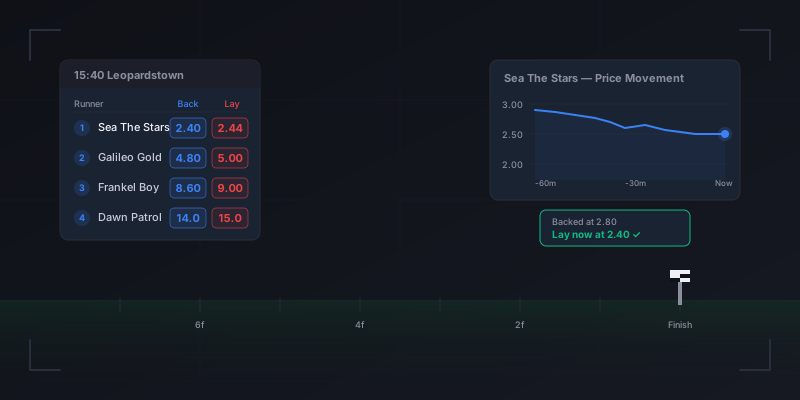
Price movement is where the profit lives. Horses can open at 10.00 on the overnight market and be trading at 5.00 by post time, or drift from 3.00 to 6.00 based on paddock reports, going changes, or late money from connections. These moves are not random. They follow patterns that experienced traders learn to anticipate. The combination of volume, volatility, and predictable information flow makes racing the ideal exchange sport for anyone willing to study the market rather than just pick winners.
Strategy 1: Betfair SP vs Fixed Odds - When to Take a Price
Betfair Starting Price is a powerful tool that most bettors underuse. The SP is calculated algorithmically from the state of the exchange market at the moment the race starts. It incorporates all the late money, all the information, and all the sentiment. The question for every race is whether you are better off locking in a fixed exchange price early or letting the market determine your price at the off.
The answer depends on your information edge. If you have identified value in the morning market, before the broader market has absorbed key information (a positive schooling report, a jockey booking that signals intent, or your own superior form analysis), take the fixed price. You are betting that the market will eventually agree with you, and you want to secure the value before it disappears.
Conversely, if your edge is marginal, if you think a horse is roughly fair at its current price but might drift, SP can work in your favour. On Irish racing specifically, SP tends to be generous on runners in large-field National Hunt handicaps where late scratchings and market adjustments push prices outward. Tracking SP versus morning prices across a season of Irish handicaps reveals a consistent pattern: roughly 35% of runners go off at a higher SP than their morning price, and in fields of 16 or more, that figure rises to 42%.
Step by Step
- At 09:00 on race day, note the exchange price for your selected runner. Record this as your "morning line."
- Assess your confidence level. High confidence (strong form edge, positive information): back at the fixed morning price. Medium confidence: place half your stake at the fixed price and half at SP. Low confidence but positive value: take SP entirely.
- Track results over 100 races, comparing your fixed-price returns against what you would have achieved at SP. This data will tell you whether your morning judgement adds value or whether you are consistently better off trusting the market.
Worked Example: SP Trading on an Irish Handicap Hurdle
A 16-runner handicap hurdle at Galway. Your selection is available at 9.00 on the exchange at 10:00. You assess high confidence based on trainer form at the track and a ground switch to yielding, which suits. You back at 9.00 for EUR 25 (potential return EUR 200). The horse is well supported late and goes off at Betfair SP of 6.40. By taking the fixed price, you captured an extra 2.60 points of value, worth EUR 65 on your stake. If the horse wins, you collect EUR 200 instead of EUR 135. Over a season of 80 such plays, capturing even 1.50 points of average SP advantage generates approximately EUR 3,000 in additional profit on EUR 25 stakes.
Risk level: Low. You are not adding new risk by choosing between fixed and SP. You are optimising the price you receive on bets you would place regardless. The discipline is in honest self-assessment: if your morning judgements are not consistently beating SP, stop taking early prices and use SP until your analysis improves.
Strategy 2: Exploiting Place Market Inefficiencies
Exchange place markets are consistently less efficient than win markets. The reason is simple: fewer people trade them, so prices take longer to correct. In large-field Irish handicaps, this inefficiency becomes a genuine edge for traders who understand how place terms interact with field size and market conditions.
The richest opportunities appear in races with 16 or more runners, where the exchange offers 4 places. The Galway Plate, the Galway Hurdle, the Irish Cambridgeshire, and big-field Leopardstown handicaps are prime examples. In these events, the place market often overprices runners that have a high each-way profile, horses with strong place records but a modest win strike rate. The win market correctly prices them as unlikely winners, but the place market underestimates their consistency.
Step by Step
- Identify races with 16 or more runners, where 4 places are paid on the exchange.
- Filter for runners with a place strike rate above 40% in similar race conditions (class, distance, going) but a win strike rate below 15%. These horses place far more often than they win.
- Compare the exchange place price against your estimated true place probability. If the place price implies a 25% chance (4.00) but your analysis suggests 38%, you have a value back bet.
- Back in the place market. Alternatively, lay the place on runners you believe are overbet to place, typically short-priced favourites in large fields where the favourite trap applies.
Worked Example: Place Backing at the Galway Festival
A 20-runner Galway Plate. You identify a horse with a 45% place record on soft ground, priced at 5.50 in the exchange place market (implied probability 18.2%). Your analysis puts the true place probability at 35%. You back to place at 5.50 for EUR 40. If the horse finishes in the first four, you collect EUR 180. Over a festival of 10 such plays, you expect 3.5 to place. At EUR 180 per placing minus EUR 40 x 10 = EUR 400 outlay, expected return is EUR 630, netting EUR 230 profit. The edge is real because the place market simply does not attract enough sharp money to correct these prices before the off.
Risk level: Medium. Place betting reduces variance compared to win betting, but the prices are lower, so you need a higher strike rate to profit. The edge erodes in smaller fields where the place market is more efficient. Stick to fields of 16 or more for best results.
Strategy 3: Trading Ground Changes in Irish National Hunt Racing
Irish National Hunt racing is uniquely sensitive to ground conditions. The west coast tracks, Galway, Limerick, Listowel, can change from Good to Heavy within hours after Atlantic weather systems arrive. East coast tracks like Leopardstown and Fairyhouse are more predictable but still see significant going changes during the winter season. These changes create trading opportunities that do not exist in flat racing or in UK racing to the same degree.
The market reacts to going changes, but it reacts slowly. When the going at Leopardstown moves from Yielding to Soft at 10:00 on race morning, the exchange prices at 10:15 have typically adjusted by only 30-40% of the eventual shift. Full adjustment often does not arrive until 30 minutes before post time, when on-course money confirms the new conditions. This lag is your window.
Step by Step
- Follow Met Eireann forecasts and Racing Post going updates from the evening before. Set alerts for tracks where you have form data.
- When the going changes by two stages or more (e.g., Good to Yielding to Soft), check the favourite's going record on the new surface.
- If the favourite has no form or a poor record on the new going, lay early. If an unfancied runner has a strong record on the changed ground, back early.
- Exit positions by 30 minutes before post time when the on-course correction typically arrives. You do not need to predict the race result, only the market adjustment.
Worked Example: Ground Change at Leopardstown
A Grade 2 novice chase at Leopardstown in January. Overnight rain changes the going from Yielding to Soft. The favourite, a slick jumper with all form on Good to Yielding, is 2.60 on the exchange at 09:30. His record on Soft ground: 0 wins from 5 starts. You lay at 2.60 for EUR 50 (liability EUR 80). By 13:00, informed money has drifted the price to 3.40. You back at 3.40 for EUR 38.24 to lock in EUR 11.76 profit regardless of result. Total time invested: monitoring one price for three hours. The trade required no opinion on the actual winner, only a correct reading of how the market would react to the going change.
Risk level: Medium-Low. The risk is that the market does not adjust, either because the going change was already priced in or because the favourite handles the new ground better than its record suggests. A stop-loss at 10-15% of your liability keeps individual losses manageable. Over a full National Hunt season, you might find 20-25 qualifying situations.
Strategy 4: Laying Short-Priced Favourites in Irish Racing
Favourites in Irish racing, particularly in National Hunt, underperform their implied probability more consistently than in UK flat racing. This is partly structural: Irish fields are often smaller, but the going is less predictable, and trainer intent is harder to read. A horse sent off at 1.50 in a maiden hurdle at Fairyhouse carries an implied win probability of 66.7%, but historical data shows Irish jumps favourites at this price range win closer to 60-62% of the time.
That 4-5% gap is your edge. It is not large per race, but across 150-200 qualifying races per season, it compounds into meaningful profit. The approach is mechanical. You define the criteria, lay every qualifier, and let the numbers work over a large sample. This is one of the core lay betting strategies that experienced traders build a bankroll foundation on.
Step by Step
- Define your scope: Irish National Hunt racing, favourites priced between 1.40 and 1.80 at 30 minutes before post time.
- Lay every qualifier at a fixed percentage of bankroll. With EUR 1,500 and 3% risk per lay, your maximum liability is EUR 45.
- Do not cherry-pick. The edge exists across the full sample. Selecting within the sample introduces bias and typically destroys the edge.
- Review after every 50 lays. If the favourite win rate exceeds 65% over 100 lays, reassess your odds range.
Worked Example: Season-Long Favourite Laying
Over a National Hunt season (October to April), you identify 160 qualifying lays. Average lay odds: 1.60. Stake: EUR 60 per lay (average liability: EUR 36). Of 160 favourites, 98 win (61.3%) and 62 lose. On the 98 winners, you pay EUR 36 x 98 = EUR 3,528. On the 62 losers, you collect EUR 60 x 62 = EUR 3,720. Net profit: EUR 192. That is a modest return, but it was generated with minimal analysis time and near-zero emotional involvement. Commission at 3% through a broker exchange tool costs approximately EUR 112 on the winning lays, leaving net profit of roughly EUR 80. At 2% commission via SportMarket PRO, commission drops to EUR 74, and net profit rises to EUR 118.
Risk level: Low-Medium. Individual liability is small. The risk is a prolonged run of favourites winning above expectation. Position sizing at 2-3% of bankroll ensures you survive these runs. The strategy requires patience and a genuine commitment to not interfering with the system.
Course-Specific Insights for Exchange Traders
Not all racecourses trade the same way on exchanges. Liquidity, price behaviour, and the type of information that moves markets vary significantly by venue. Here is what experienced traders know about the key Irish and UK courses.
Leopardstown
The flagship Dublin track sees excellent liquidity on festival days (Christmas, Dublin Racing Festival in February) but thinner markets on routine midweek cards. On festival days, Grade 1 races attract six-figure matched volumes, and prices are sharp, meaning less opportunity for lazy value. The edge comes from ground knowledge. Leopardstown's chase course rides differently to the hurdle course, and sections near the far side can ride heavier than the official going suggests. Traders who factor this in find value that the broader market misses.
The Curragh
Ireland's premier flat track. Exchange liquidity is excellent for Group races and Classics, but thin for maidens and lower-grade races. The draw bias on certain ground conditions (high-numbered stalls favoured on soft ground over sprint trips) is well documented but inconsistently priced by the exchange market. Pre-race trading on Curragh Classics (Irish Derby, Irish Oaks) is profitable because prices move significantly between the overnight market and post time as stable confidence becomes apparent.
Galway
The summer festival is one of the best weeks of the year for exchange trading. Large fields, competitive handicaps, and a betting public that backs on sentiment rather than form create persistent inefficiencies. Place markets are particularly rich during Galway week. The track itself favours prominent racers, and front-runners that hold a position coming down the hill often outperform their price. This is a known angle but still underpriced in the exchange market most years.
Cheltenham
The most liquid horse racing exchange market in the world. Cheltenham Festival races regularly see seven-figure matched volumes. Prices are extremely sharp, and finding raw value is difficult. The opportunity lies in pre-race trading rather than outright betting. Prices move dramatically throughout the morning as UK and Irish punters pile in. Back-to-lay trading on well-supported Irish runners works well because the Irish-trained contingent tends to attract late confidence money that shortens prices by 15-25% between 10:00 and post time. Exchange platforms with the lowest latency give traders the best fills during the frantic final minutes before a Cheltenham race.
Pre-Race Trading vs In-Play Trading
These are fundamentally different disciplines that share an exchange platform but require distinct skills, bankrolls, and temperaments.
Pre-race trading is analytical. You study the market, identify a price that will move, enter your position, and wait. Time frames range from minutes to hours. The skills are form analysis, market reading, and patience. A bankroll of EUR 500 to EUR 1,000 is sufficient because you are trading small price movements with controlled liability. Most of the strategies in this guide fall into this category.
In-play trading is reactive. You watch the race unfold and trade price movements as they happen. A horse that jumps poorly at the second fence in a Leopardstown chase might see its price spike from 3.00 to 8.00 in seconds. If you are quick enough and correctly assess whether the incident is race-ending or recoverable, you can back at the inflated price and trade out when the price corrects. The skills are speed, judgement under pressure, and an intimate knowledge of how specific race scenarios affect prices. You need a larger bankroll (EUR 1,500 minimum) because mistakes are more expensive and happen faster.
Most profitable racing traders specialise in one or the other. Trying to do both simultaneously splits your attention and degrades performance in both. Start with pre-race trading, build your bankroll and market knowledge, and only move to in-play once you have a solid foundation and can afford to fund a separate in-play bankroll.
Tools for Racing Exchange Traders
Manual trading on the exchange website is viable for casual traders, but serious racing traders use dedicated software. These tools provide faster execution, automation, and analytical features that the standard exchange interface cannot match.
Bet Angel is the most widely used trading tool for horse racing. It offers one-click trading, customisable ladders, automation via spreadsheet triggers (Guardian), and advanced charting. For pre-race trading, the ladder interface lets you queue bets at specific prices and cancel or adjust instantly. For in-play, the speed advantage over the website is significant. A Bet Angel licence runs at approximately EUR 7 per month for the basic version.
Geeks Toy is a lighter, faster alternative favoured by scalpers and in-play traders. The interface is stripped back compared to Bet Angel, but execution speed is marginally faster. If your strategy involves capturing one or two ticks on many trades (scalping), Geeks Toy is the tool of choice. Monthly cost is approximately EUR 5.
Betfair API access allows you to build custom bots and data tools. If you have programming ability (Python is the most common language used), the API lets you automate any strategy entirely. You can pull live market data, place and cancel bets programmatically, and run backtests against historical data. Many professional racing traders run fully automated strategies via the API, executing dozens of trades per day without manual intervention. Broker platforms like AsianConnect (OrbitX) and BetInAsia (SharpXchange) also offer API access for their exchange tools.
Risk Management for Racing Traders
Racing markets move fast, and losses accumulate quickly if your risk controls are weak. The rules below apply to every strategy discussed in this guide.
Daily loss limit: set a maximum daily loss and stop trading when you hit it. A sensible figure is 5% of your total racing bankroll. If you start the day with EUR 2,000, stop at EUR 100 down. Chasing losses on the final race of the day is the fastest way to destroy a bankroll.
Per-trade exposure: never risk more than 3% of your bankroll on a single position. For a EUR 1,500 bankroll, that means a maximum liability of EUR 45. This feels small when you are confident, but confidence is not the same as edge. Even strong strategies produce losing streaks of 8-12 trades.
Separate bankrolls: if you trade multiple strategies (SP trading, place markets, favourite laying), keep separate bankrolls and track each independently. This prevents a losing strategy from being hidden by a winning one.
Commission awareness: on a high-volume trading strategy, commission is your single largest cost. A trader placing 300 trades per month at an average matched volume of EUR 50 pays EUR 750 in commission at 5%. Through a broker at 3%, that drops to EUR 450. The EUR 300 annual saving across 12 months is EUR 3,600, enough to fund an additional strategy bankroll. See the exchange football betting guide for more on how commission structures affect strategy selection.
Expert Tip
One of the most consistently overlooked exchange trading opportunities in Irish racing is the Punchestown Festival in late April. Because it falls after Cheltenham and Aintree, public attention has moved on and casual punters are less active. But the quality of racing is exceptional, with many Cheltenham runners reappearing. Exchange liquidity is good on the feature races but the markets are noticeably softer than at Cheltenham. The result is that back-to-lay trades on well-fancied Irish-trained runners produce a higher average profit per trade at Punchestown than at any other Irish festival. Over the past five seasons, runners that shortened at Cheltenham have followed the same pattern at Punchestown but with less market resistance, creating a wider trading window. Build your Punchestown trading plan around the Cheltenham form book, and you will find value that the depleted post-season market consistently fails to correct.
Access Horse Racing Markets with the Lowest Commission
Commission is the hidden drain on every racing trader's results. Betfair's standard 5% commission on net winnings, rising further with the Premium Charge for profitable accounts, eats directly into your edge. Broker exchange tools offer the same Betfair liquidity at reduced commission rates, typically 2-3%. For a trader placing 200 or more trades per month, the savings are substantial.
BetInAsia provides exchange access via SharpXchange, combining low commission with Asian bookmaker coverage for those who also bet on international racing in Hong Kong or Australia. AsianConnect routes through OrbitX, one of the most established white-label Betfair platforms, with reliable execution speed for pre-race and in-play trading. MadMarket offers FairExchange, a clean interface that suits traders who want simplicity without sacrificing functionality. And SportMarket PRO is the professional's choice, offering the lowest commission tiers and a combined view of exchange and bookmaker prices that is invaluable for arbitrage and value identification across markets.
For racing traders specifically, the key comparison points are commission rate, execution speed on the exchange tool, and whether the platform supports third-party software (Bet Angel, Geeks Toy, API access). All four brokers listed above support these integrations. The right choice depends on your trading volume and whether you also bet on other sports or markets alongside racing.
Frequently Asked Questions
Is horse racing the best sport for exchange trading?
Horse racing offers the deepest liquidity and most frequent price movements of any exchange sport. A typical UK or Irish race sees significant market activity from the overnight stage through to the off, with prices moving 20-50% on many runners. Football offers fewer but larger swings, while tennis has fast in-play movement. For pure trading volume and opportunity count, racing is unmatched. A full Saturday card gives you 30 or more tradeable markets, each with distinct price dynamics.
How much bankroll do I need to start trading horse racing on exchanges?
For pre-race trading, a starting bankroll of EUR 500 to EUR 1,000 is realistic. You will be placing trades in the EUR 20 to EUR 50 range and targeting small percentage gains per trade. In-play trading requires more because prices move faster and you need larger stakes to capture smaller tick movements. A minimum of EUR 1,500 is advisable for in-play. In both cases, never risk more than 3-5% of your bankroll on a single position, and track every trade in a spreadsheet.
What is the difference between Betfair SP and taking a fixed exchange price?
Betfair SP (Starting Price) is calculated from the final state of the exchange market at the off. If you take SP, you accept whatever price the algorithm determines. If you take a fixed exchange price, you lock in that number. SP is useful when you believe the market will move in your favour but cannot monitor the price. Fixed prices are better when you have identified value early and want to secure it before the market corrects. Many profitable bettors use a mix: take a fixed price on strong opinions, use SP when the edge is marginal and the market might still move.