
Master Lay Betting: Understand Liability and Place Smarter Bets
Lay betting is the ability to bet against an outcome, and it is the single feature that makes exchange betting fundamentally different from using a bookmaker. If you have only ever backed selections, understanding how to lay opens up an entirely new dimension of strategy, risk management, and profit extraction. This guide breaks down the mechanics, the maths, and the practical applications that experienced bettors use every day.
What Is a Lay Bet and How Does It Work?
When you lay a selection on an exchange, you are betting that it will not win. You are taking the opposite position to the backer. If the selection loses, you keep the backer's entire stake. If the selection wins, you pay the backer their winnings. In practical terms, you are acting as the bookmaker for that specific bet.
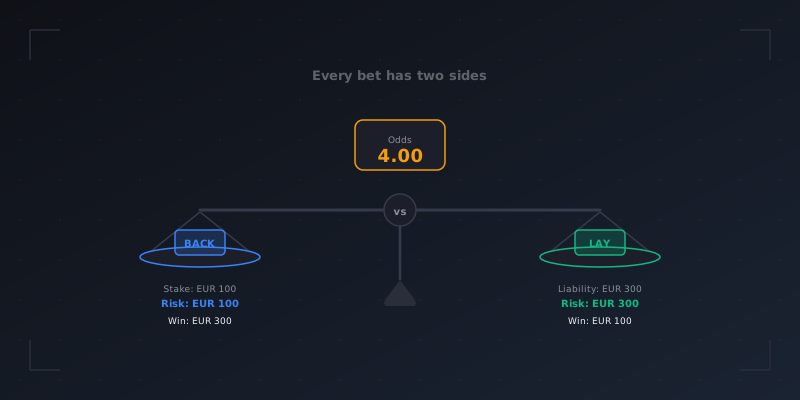
Every bet on an exchange requires two parties. The backer risks their stake to win a multiple of it. The layer risks a larger amount (the liability) to win the backer's stake. This asymmetry is the defining feature of lay betting. Your potential profit is fixed (the backer's stake), while your potential loss is the liability, which increases with the lay odds.
Here is the critical formula you need to internalise:
- Liability = Backer's stake x (Lay odds - 1)
- Profit if selection loses = Backer's stake (minus commission)
- Loss if selection wins = Liability
The exchange calculates your liability automatically and reserves that amount from your account balance before the bet is matched. You cannot lose more than the displayed liability on any single lay bet. There is no margin call, no additional exposure. This is a hard cap enforced by the platform.
Understanding Liability: The Numbers That Matter
Liability is where most newcomers to lay betting get tripped up. The concept is straightforward once you work through a few examples, but the consequences of misjudging liability can be expensive. Let us walk through three scenarios at different odds levels.
| Scenario | Lay odds | Backer's stake | Your liability | Your profit if it loses |
|---|---|---|---|---|
| Short favourite | 1.50 | EUR 100 | EUR 50 | EUR 97 (at 3% commission) |
| Mid-range selection | 4.00 | EUR 100 | EUR 300 | EUR 97 (at 3% commission) |
| Outsider | 12.00 | EUR 100 | EUR 1,100 | EUR 97 (at 3% commission) |
The pattern is stark. Laying a short-priced favourite at 1.50 means risking EUR 50 to win EUR 97. The risk-reward ratio is attractive. Laying an outsider at 12.00 means risking EUR 1,100 to win the same EUR 97. Unless your strike rate on outsider lays is extremely high (above 91% in this case), the maths does not support it.
This is why experienced lay bettors overwhelmingly focus on selections between 1.50 and 6.00. Within that range, the liability-to-reward ratio remains manageable, and the strike rate required for profitability is realistic. Laying anything above 8.00 is generally reserved for specific strategies like hedging or trading, not standalone lay bets.
Example: Lay Bet on a Football Match
Arsenal are playing at home and the lay odds on the draw are 4.20. You lay the draw for EUR 50 (backer's stake). Your liability is EUR 50 x (4.20 - 1) = EUR 160. If the match ends in a home win or away win, you pocket EUR 48.50 (EUR 50 minus 3% commission). If it ends in a draw, you lose EUR 160. In a typical Premier League season, draws occur in roughly 25% of matches. If you lay the draw consistently at 4.20, you need draws to happen less than 23.3% of the time in your selected matches to break even after commission. Your edge comes from identifying specific fixtures where the draw probability is genuinely below the market-implied level.
When to Use Lay Bets: Four Core Applications
Lay betting is not a single strategy. It is a tool with multiple applications. How you use it depends on what you are trying to achieve.
1. Standalone lay betting. You identify selections that you believe are overvalued by the market and lay them outright. This is the purest form of lay betting. You are expressing a view that something is less likely to happen than the odds suggest. Horse racing is the classic arena for this, where short-priced favourites in competitive handicaps frequently get beaten. A favourite at 2.50 implies a 40% win probability. If your assessment is that the true probability is 33%, laying represents positive expected value.
2. Hedging and locking in profit. You hold an existing back bet and want to guarantee a return before the event finishes. If you backed a horse at 8.00 pre-race and it shortens to 3.00 in-play, laying at 3.00 locks in profit regardless of the result. This is the most common use of lay bets among experienced exchange users and is the foundation of in-play trading.
3. Matched betting. Lay bets are essential for matched betting, where you back a selection with one bookmaker (often using a free bet or bonus) and lay the same selection on an exchange to eliminate risk. The lay bet ensures you profit from the bookmaker's promotion regardless of the outcome. This requires precise calculation of lay stakes to balance the back and lay positions.
4. Trading positions. Exchange traders use lay bets as part of a trading sequence. You might back at 3.00 and lay at 2.80 as the price shortens, or lay first at 2.80 and back at 3.00 as the price drifts. The profit comes from the price movement, not from the event outcome. This is structurally identical to buying and selling on a financial exchange. Traders who use this approach often close their positions before the event starts, taking no risk on the actual result.
Common Mistakes Beginners Make with Lay Betting
The mechanics of lay betting are simple. The mistakes that cost money tend to be about judgement rather than understanding.
Laying at too-high odds. The most expensive beginner error is laying selections at odds of 8.00, 10.00 or higher without appreciating the liability implications. A EUR 20 lay at 10.00 creates EUR 180 in liability. One loss wipes out the profit from nine winning lays. Unless you have a very specific information edge on long-odds selections, stick to laying between 1.50 and 6.00 where the risk-reward profile is more forgiving.
Ignoring commission in calculations. Commission is deducted from your net profit on each market. At 3% commission, your EUR 100 profit becomes EUR 97. This matters more than it appears, because your losing lays pay the full liability with no commission offset. Over a large sample of bets, failing to account for commission in your expected value calculations will make marginally profitable strategies unprofitable.
Overlaying the field. In horse racing, some bettors lay multiple runners in the same race, thinking they are diversifying. In reality, you are increasing your exposure to the one outcome you did not lay. If you lay three horses in a six-runner race and the fourth horse wins, all three of your lays profit. But if any of the three win, you take the full liability hit. Laying more than one or two runners in the same race requires careful staking to ensure the combined liability does not exceed your acceptable risk.
Not adjusting for in-play volatility. Lay odds swing dramatically during live events. A football favourite at 1.80 pre-match might drift to 3.50 after an early goal against them. Laying in-play requires faster decision-making and a clear exit strategy. If you do not have a predefined trade-out point, you risk holding a position that moves sharply against you with no plan to limit the damage.
Lay Betting Across Different Sports
Horse racing. This is where lay betting originated and where it remains most popular. Fields of 8 to 20 runners mean every favourite faces genuine competition. Irish National Hunt racing is particularly fertile ground for lay bettors because of the unpredictability of jumps, the influence of ground conditions, and the relatively high proportion of favourites that get beaten. A well-timed lay on a 2.50 favourite on soft ground at Leopardstown, where the horse's form is primarily on good ground, is the kind of nuanced bet that separates informed layers from random punters.
Football. Laying the draw is the most popular football lay strategy, and for good reason. Draws are inherently difficult to predict, and the odds typically sit between 3.20 and 4.50, offering manageable liability. The key is selectivity: targeting matches where at least one side has a strong incentive to attack, reducing the probability of stalemate below what the market implies. Laying individual match results (backing against the favourite) also has value in cups and derbies where form is less predictive.
Tennis. Lay betting in tennis focuses on identifying overvalued favourites, particularly in early-round Grand Slam matches where seeded players sometimes face tricky opponents on unfamiliar surfaces. The two-outcome structure (no draws) simplifies the analysis. However, in-play tennis markets move extremely fast, so pre-match laying is more practical for most bettors than attempting to trade live.
GAA. For Irish bettors, Gaelic football and hurling offer niche lay opportunities. Liquidity is lower than mainstream sports, but this cuts both ways. Prices can be less efficient, and local knowledge (team news, ground conditions, county board politics affecting team selection) can provide a genuine information edge. If you follow a specific county circuit closely, you may spot lay value that the broader market misses.
Expert Tip
When laying a favourite in horse racing, check the Betfair "Matched Amount" column 30 minutes before the off. If the matched volume on your target horse has increased significantly without the price moving, it often indicates informed money supporting the favourite. Conversely, if the price is drifting despite high volume, the smart money may be opposing it, validating your lay. This volume-price divergence signal is one of the most reliable short-term indicators available on exchange markets and is completely invisible to bookmaker-only bettors.
Start Laying: Get Exchange Access
Lay betting requires an exchange account. If you already have direct Betfair access, you can start placing lay bets on any market. If direct access is restricted, complicated by premium charges, or you prefer the broker model, platforms like BetInAsia (SharpXchange), AsianConnect (OrbitX), MadMarket (FairExchange) and SportMarket (PRO) all support full lay betting functionality with competitive commission rates.
To understand the broker advantage in more detail, read why sharp bettors use brokers. Or if you are ready to open an account, head to our getting started guide and place your first lay bet today.
Frequently Asked Questions
What does it mean to lay a bet?
Laying a bet means betting against an outcome. You are taking the opposite side to a backer. If the outcome does not happen, you keep the backer's stake. If it does happen, you pay out the winnings. On an exchange, you can lay any selection in any market, effectively acting as the bookmaker for that specific bet.
How is lay bet liability calculated?
Liability equals the backer's stake multiplied by (lay odds minus 1). For example, if you lay a selection at 5.00 for EUR 20, your liability is EUR 20 x (5.00 - 1) = EUR 80. This is the maximum you can lose on that lay bet. You must have this amount available in your exchange account before the bet can be matched.
Can you lose more than your liability on a lay bet?
No. Your liability is calculated and reserved at the time the bet is matched. The exchange holds this amount in escrow. Your maximum loss on any lay bet is always the liability figure shown before you confirm the bet. There is no scenario where additional funds are required after matching.
What sports are best for lay betting?
Horse racing and football offer the deepest liquidity and most opportunities for lay betting. Horse racing is particularly suited because fields of 8-20 runners create natural laying opportunities on short-priced favourites. Football lay bets on the draw or specific match outcomes benefit from high in-play liquidity, enabling trade-out strategies.