
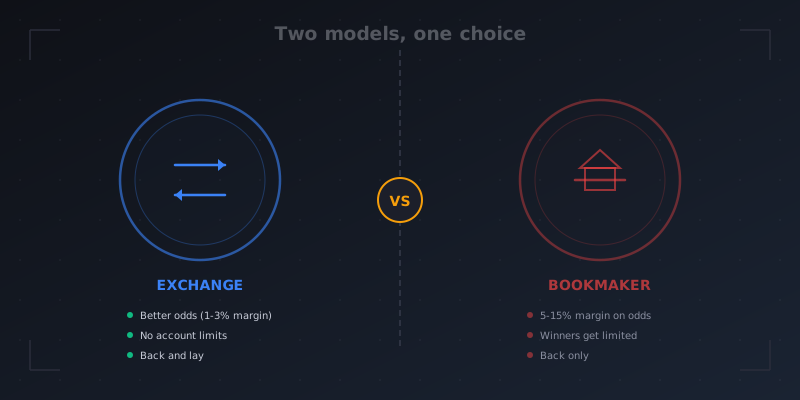
See Why Exchange Betting Outperforms Traditional Bookmakers
Every experienced bettor eventually faces the same question: should I stay with traditional bookmakers or move to an exchange? The answer depends on what you are trying to achieve. If you bet for entertainment with small stakes, bookmakers serve that purpose. If you bet to generate consistent profit over time, the structural advantages of exchanges are difficult to ignore. This comparison lays out the differences with real numbers so you can make an informed choice.
Two Fundamentally Different Business Models
The single most important difference between bookmakers and exchanges is how they make money. Understanding this explains every other difference that follows.
A bookmaker is a counterparty to your bet. When you back a horse at 4.00 with Paddy Power, Paddy Power is on the other side. If the horse wins, they pay you. If it loses, they keep your stake. Their profit comes from setting odds that are systematically lower than true probability. The gap between the true odds and the offered odds is called the overround, and it typically ranges from 5% on competitive football markets to 15% or more on niche sports. This margin is applied to every market, every bet, regardless of whether you win or lose.
An exchange is a marketplace. When you back a horse at 4.00 on Betfair, another bettor is laying that horse. The exchange simply matches the two of you, holds the funds, and takes a commission on the winner's net profit. The exchange has no opinion on the outcome and no financial interest in your bet losing. Their revenue comes from transaction volume, not from client losses. This distinction is not philosophical. It has direct, measurable consequences for how you are treated as a customer.
When a bookmaker identifies you as a consistent winner, you become a liability. The rational response from their perspective is to limit your stakes or close your account. When an exchange identifies you as a high-volume trader, you become a valuable client generating commission revenue. The rational response is to keep you active. This is why bookmaker account limitations are endemic among profitable bettors, while exchange accounts remain unrestricted indefinitely.
Head-to-Head: Exchange vs Bookmaker on Every Metric
| Metric | Betting Exchange | Traditional Bookmaker |
|---|---|---|
| Odds quality | Market-driven, 1-3% margin | Bookmaker-set, 5-15% margin |
| Cost structure | 2-5% commission on net wins only | Margin on every bet, win or lose |
| Account restrictions | None for winners | Routine for profitable bettors |
| Lay betting | Available on every market | Not offered |
| In-play trading | Full order book, trade in/out | Cash-out at bookmaker's price |
| Price transparency | Full order book visible | Single price, take it or leave it |
| Market depth | Varies by event (high on major sports) | Bookmaker accepts up to their limit |
| Promotions | Minimal | Free bets, BOG, enhanced odds |
| Best for | Sharp bettors, traders, long-term profit | Casual bettors, promotions, entertainment |
The pattern across every metric tells a consistent story. Bookmakers offer convenience, promotions, and simplicity. Exchanges offer better prices, more flexibility, and sustainable access for winners. If your betting activity is primarily promotional (free bet extraction, price boosts, sign-up offers), bookmakers still have value. For everything else, the exchange wins on the numbers.
Real Odds Comparison: How Much Are You Leaving on the Table?
The theoretical argument for exchange odds is well established. But how does it translate into actual money? Here are three examples from markets Irish bettors regularly trade.
Example: Premier League Match Odds
Liverpool vs Aston Villa. The bookmaker average for a Liverpool win is 1.65. On the exchange, the back price is 1.72. You stake EUR 200 on Liverpool to win. With the bookmaker, your potential profit is EUR 130. On the exchange, your gross profit is EUR 144. After 3% exchange commission, your net profit is EUR 139.68. That is EUR 9.68 more for the same bet on the same outcome. Scale this across 200 bets per year at similar stakes and the difference exceeds EUR 1,900.
Irish horse racing. A 6-runner race at Leopardstown. The bookmaker favourite is priced at 2.50. The exchange back price is 2.72. On a EUR 100 stake, the bookmaker pays EUR 150 profit. The exchange pays EUR 172 gross, minus 3% commission on the win (EUR 5.16), netting EUR 166.84. That is EUR 16.84 per winning bet. Over a season of 150 winning bets on similar selections, the gap is approximately EUR 2,500.
League of Ireland. Smaller markets have wider exchange spreads, reducing the edge. Shamrock Rovers at home might be 1.50 with bookmakers and 1.53 on the exchange. The per-bet difference is smaller (EUR 6 on a EUR 200 stake), but it still accumulates. And crucially, on the exchange you can also lay the opposition or trade in-play, options that do not exist with a bookmaker.
The odds advantage compounds over time because it applies to every single bet. A 3% improvement in average odds across 500 annual bets at EUR 100 average stake is EUR 1,500 in additional value before commission. After commission, you keep roughly EUR 1,300 of that. This is not speculative. It is arithmetic, and it is why professionals treat exchange access as non-negotiable infrastructure rather than an optional preference.
True Cost: Bookmaker Overround vs Exchange Commission
The cost of betting with a bookmaker is hidden inside the odds. The cost of exchange betting is explicit in the commission. Comparing them requires converting both to the same metric.
A typical three-way football market at a bookmaker has a combined implied probability of 107-110%. The overround is 7-10%. This means for every EUR 100 staked across all outcomes, the bookmaker retains EUR 7-10 regardless of the result. This cost is borne by every bettor on every bet, whether they win or lose.
On an exchange, the combined implied probability of the same market might be 101-102%. The 1-2% margin reflects the spread between back and lay prices. Commission at 3% applies only when you net positive on a market. If you lose, you pay zero commission. This asymmetry is enormously valuable over large sample sizes because roughly half your bets will lose, and on those bets, the exchange costs you nothing.
Example: Annual Cost for a EUR 50,000 Turnover Bettor
You place 500 bets per year at EUR 100 average stake. Your strike rate is 45% on average odds of 2.50, generating gross profit of EUR 6,250. With a bookmaker charging an average 8% overround, your effective cost is approximately EUR 4,000 embedded in worse odds (you are paid less on every winner and lose the full stake on every loser at inflated probabilities). With an exchange at 2% effective margin plus 3% commission on EUR 6,250 profit, your total cost is approximately EUR 1,188 (EUR 1,000 from the spread + EUR 188 commission). The bookmaker route costs EUR 2,800 more per year for the same betting activity. Over five years, that difference is EUR 14,000.
The Winning Bettor's Journey: From Bookmaker to Exchange
Almost every profitable bettor in Ireland follows a recognisable path. The timeline varies, but the stages are consistent.
Stage 1: Bookmaker beginnings. You start betting with one or two Irish bookmakers. Paddy Power, BoyleSports, Bet365. You take advantage of sign-up offers, enhanced odds, and Best Odds Guaranteed on racing. At this stage, bookmakers are useful and the promotional value is real. You might even turn a profit from offer extraction alone.
Stage 2: The first limitation. After three to six months of consistent profitability, one of your accounts gets limited. Stakes are cut from EUR 200 to EUR 5. Enhanced odds disappear. You open accounts with other bookmakers and the cycle repeats. Within 12 months, most profitable Irish bettors have been limited by two or three operators. The frustration is acute because you played within the rules and won fairly.
Stage 3: Exchange discovery. You open a Betfair account and discover the exchange. Suddenly, there are no stake limits tied to your win rate. You can back, lay, and trade. The odds are visibly better. You start moving your serious volume to the exchange and using bookmaker accounts only for residual promotional value. This stage typically lasts one to three years of profitable exchange betting.
Stage 4: The Expert Fee hits. As your lifetime exchange profits accumulate, Betfair's Expert Fee kicks in. Your effective cost jumps from 5% to 20% or higher. The exchange that freed you from bookmaker limitations now has its own extraction mechanism for winners. This is the stage where most sharp bettors discover the broker model.
Stage 5: Broker access. You open an account with BetInAsia ↗, AsianConnect, MadMarket, or SportMarket. Exchange access through the broker gives you the same Betfair liquidity at lower commission with no Expert Fee and no personal account risk. Your betting infrastructure is now sustainable. Many professional bettors operate at this stage for years, if not permanently. For a full exploration of broker advantages, read our guide on why sharp bettors use brokers.
Expert Tip
Use bookmaker prices as a calibration tool for finding exchange value. Before placing a back bet on the exchange, check the same selection across three or four bookmakers. If the average bookmaker price is 3.00 and the exchange back price is 3.20, you are getting genuine value because the bookmaker price already includes their margin. If the exchange price is 2.95 (below the bookmaker average), the exchange market may be overvaluing that selection, and a lay could be the smarter play. This cross-referencing technique costs nothing, takes 30 seconds, and consistently identifies mispriced exchange markets that pure exchange traders miss.
When a Bookmaker Is Still the Better Choice
Intellectual honesty requires acknowledging where bookmakers still offer value. Three specific scenarios favour the bookmaker route.
Best Odds Guaranteed (BOG). Many Irish bookmakers offer BOG on horse racing, meaning if you take an early price and the SP is higher, they pay the SP. This protection has genuine value. On the exchange, if the price drifts after you back, you are stuck at your original price unless you trade out and re-enter. For ante-post racing bets, BOG is worth the bookmaker margin.
Promotional offers. Free bets, deposit matches, and enhanced odds are real money. A EUR 50 free bet at 80% extraction rate puts EUR 40 in your pocket. If you have access to bookmaker accounts that are not yet limited, extracting promotional value is mathematically positive. Combine bookmaker promotions with exchange lay bets for risk-free extraction via matched betting.
Niche markets with thin exchange liquidity. If you want to bet on League of Ireland under/over corners or GAA handicaps, the exchange may have minimal or zero liquidity. Bookmakers will quote you a price on almost any market. The odds may be worse, but the ability to actually get matched is worth the premium.
For everything else, the numbers point to exchanges. The combination of better odds, no account restrictions, lay betting capability, and in-play trading makes the exchange the structurally superior platform for any bettor operating above a recreational level. Accessing that exchange through a broker further improves the economics by eliminating the Expert Fee and reducing commission. Read our commission comparison for the full rate breakdown across all platforms.
Frequently Asked Questions
Are exchange odds always better than bookmaker odds?
In most cases, yes. Exchange odds are typically 2-8% better because they are set by market participants rather than a bookmaker building in a profit margin. The advantage is most pronounced on popular markets with deep liquidity (Premier League football, major horse racing). On niche markets with thin liquidity, the exchange spread can sometimes make effective odds comparable to bookmaker prices.
Why do bookmakers limit winning accounts but exchanges do not?
Bookmakers profit when customers lose, so a consistently winning bettor is a direct cost to their business. They limit stakes or close accounts to protect their margin. Exchanges earn commission on every matched bet regardless of who wins, so they have no financial incentive to restrict profitable users. Your winnings on an exchange come from other bettors, not from the platform itself.
Can I use both a bookmaker and an exchange?
Yes, and many sharp bettors do. Bookmakers are useful for Best Odds Guaranteed on horse racing, enhanced odds promotions, and as price benchmarks. Exchanges are used for the actual trading, lay betting, in-play position management and higher-volume activity. Running both gives you the promotional value of bookmakers while doing serious betting on the exchange.
What is the real cost difference between exchanges and bookmakers?
Bookmaker overround (built-in margin) typically ranges from 5% to 15% on every market, applied to every bet win or lose. Exchange commission ranges from 2% to 5% and applies only to your net winnings. On a losing bet at an exchange, you pay zero commission. Over 1,000 bets, the cumulative cost difference can exceed EUR 2,000 depending on your stake level and the markets you bet on.