
Build Long-Term Profits with Value Betting and Smart Bankroll Management
Value betting is the foundational principle of all profitable sports betting. If you consistently bet at prices that exceed the true probability of the outcome, you will make money over time. Everything else, system selection, market focus, timing, is a variation on this single idea. The challenge is not understanding the concept. The challenge is identifying value accurately, staking correctly, and surviving the variance long enough for the edge to materialise. This guide covers both halves of the equation: finding value using exchange prices as your benchmark, and managing your bankroll using the Kelly Criterion and practical staking rules that keep you solvent during inevitable losing runs. If you understand how exchanges set prices and how lay betting strategies work, you have the prerequisites. What follows is the framework for turning that knowledge into sustained, long-term profit.
What Value Betting Actually Means
A value bet exists when the odds offered by a bookmaker imply a lower probability than the actual probability of the outcome. If a horse has a 40% chance of winning a race (true odds of 2.50), and a bookmaker is offering 3.00, the bet has positive expected value. Over 100 such bets, you expect to win approximately 40 times at EUR 200 profit each (EUR 8,000 total) and lose 60 times at EUR 100 each (EUR 6,000 total). Net profit: EUR 2,000, or 20% return on investment.
The difficulty is knowing the true probability. No one knows for certain whether a horse has a 40% or 35% or 45% chance of winning. But the exchange market provides the best available estimate. The Betfair exchange price represents the aggregate opinion of thousands of sophisticated bettors and trading algorithms. It is not perfect, but it is the most accurate public estimate of true probability available. When a bookmaker's price significantly exceeds the exchange price, the bookmaker is offering value.
This is the same principle that underpins arbitrage betting. The difference is that in arbitrage, you lay the selection on the exchange to guarantee profit. In value betting, you skip the lay and accept short-term variance for higher long-term returns. The arber locks in 1-2% per bet with zero risk. The value bettor targets 3-8% ROI but must tolerate individual bets losing, and sometimes losing in streaks that test every ounce of discipline.
Closing Line Value: The Gold Standard for Measuring Your Edge
Closing Line Value (CLV) is the single most reliable predictor of long-term betting profitability. The closing line is the exchange price at the moment the market closes (the off time for horse racing, kick-off for football). It represents the most efficient price because the market has had maximum time and information to settle.
If you consistently place bets at prices higher than the closing line, you have positive CLV, and you are almost certainly a profitable bettor over the long term. The converse is also true. If your average bet is placed at prices below the closing line, you are likely to lose money regardless of short-term results.
How to Track CLV
- Record the price at which you place every bet (your "taken price").
- Record the exchange closing price for the same selection (the Betfair SP for horse racing, or the exchange match odds price at kick-off for football).
- Calculate CLV for each bet: CLV = (Your Price / Closing Price) - 1. A positive number means you beat the closing line.
- Track your average CLV across all bets. After 200+ bets, your average CLV is a reliable measure of your edge.
Worked Example: CLV Tracking Over 5 Bets
Bet 1: Backed at 3.50, closing price 3.20. CLV = (3.50/3.20) - 1 = +9.4%
Bet 2: Backed at 2.80, closing price 2.90. CLV = (2.80/2.90) - 1 = -3.4%
Bet 3: Backed at 4.00, closing price 3.60. CLV = (4.00/3.60) - 1 = +11.1%
Bet 4: Backed at 1.95, closing price 1.90. CLV = (1.95/1.90) - 1 = +2.6%
Bet 5: Backed at 5.50, closing price 5.00. CLV = (5.50/5.00) - 1 = +10.0%
Average CLV: +5.9%. This bettor is consistently beating the closing line by nearly 6%, which translates to approximately 4-6% ROI over a large sample. Even if some of these individual bets lost, the positive CLV indicates a genuine, sustainable edge.
CLV matters more than short-term profit or loss. A bettor who is down EUR 500 after 200 bets but has +4% average CLV is almost certainly experiencing normal variance and will become profitable as the sample grows. A bettor who is up EUR 500 after 200 bets but has -2% average CLV has been lucky and will likely give those winnings back. Trust the CLV over the P&L, especially in the first 500-1,000 bets.
Finding Value: Using Exchange Prices as Your True Line
The practical method for finding value bets is straightforward. Compare the bookmaker's price with the exchange price. When the bookmaker offers higher odds, the bet has potential value. The question is how much higher the bookmaker price needs to be to constitute genuine value after accounting for the exchange's own margin and the uncertainty in the "true" price.
A working rule is to look for bookmaker prices at least 3-5% above the exchange lay price. Below 3%, the margin of error in the exchange price itself may mean the value is illusory. Above 5%, the value is strong enough to bet with confidence. Above 10%, either you have found a genuine pricing error or the bookmaker knows something the exchange market does not (injury news, team selection), so verify before staking.
Finding Value in Irish Racing
Irish horse racing provides some of the best value betting opportunities available to European bettors because the markets are less efficient than their UK equivalents. Several factors create this inefficiency.
Smaller field sizes and less data: Irish handicaps, particularly at smaller tracks like Clonmel, Thurles, and Kilbeggan, attract less analytical attention from form students and algorithms. The exchange closing prices on these races are less precise than, say, a Newmarket handicap, which means bookmaker pricing errors persist longer.
Trainer and jockey patterns: Irish National Hunt racing has strong trainer-jockey combinations (Mullins-Townend, Elliott-Davy, De Bromhead-Blackmore) whose booking patterns signal intent. When a leading jockey picks up an unexpected ride at a minor meeting, the exchange market often underreacts initially. Irish bookmakers, who know their domestic market well, sometimes price these angles more accurately than the exchange, but other times they are slower to adjust, particularly on weekday cards when their trading desks are understaffed.
Ground conditions: Irish racecourses can change ground conditions dramatically during a meeting after rainfall. If the ground goes from Good to Soft between races 3 and 4, horses with strong form on Soft ground suddenly become value in race 4 onwards. The exchange market adjusts, but bookmakers who set their prices that morning based on Good ground may be slow to change. Monitoring live going reports during an Irish meeting and comparing bookmaker prices to the exchange is a consistent source of value.
The Kelly Criterion: Optimal Staking for Maximum Growth
The Kelly Criterion is a mathematical formula that calculates the optimal stake size for a bet with positive expected value. It maximises the long-term growth rate of your bankroll by staking more when your edge is larger and less when your edge is smaller. The formula is: Kelly % = (Edge / (Odds - 1)), where Edge = (Your Assessed Probability x Odds) - 1.
In practice, full Kelly staking is too aggressive for most bettors. The stakes are large, the variance is high, and a bad run can draw your bankroll down by 50% or more before recovering. This is why experienced value bettors use fractional Kelly: half-Kelly (divide the Kelly % by 2) or quarter-Kelly (divide by 4).
Full Kelly, Half-Kelly, and Quarter-Kelly Compared
Worked Example: Kelly Staking on a EUR 5,000 Bankroll
Scenario: You have identified a value bet at odds of 3.00. The exchange closing price is 2.60, implying the true probability is 38.5%. Your assessed edge: (0.385 x 3.00) - 1 = 0.155, or 15.5%.
Full Kelly: 15.5% / (3.00 - 1) = 7.75% of bankroll = EUR 387.50. This is aggressive. A losing streak of 5 similar bets would cost EUR 1,937, nearly 40% of your bankroll.
Half-Kelly: 7.75% / 2 = 3.875% = EUR 193.75. More manageable. The same 5-bet losing streak costs EUR 968, or 19% of bankroll. Painful but survivable.
Quarter-Kelly: 7.75% / 4 = 1.94% = EUR 97. Conservative. The 5-bet losing streak costs EUR 485, or 10% of bankroll. Psychologically comfortable. Growth is slower but steadier.
Recommendation: Start with quarter-Kelly. After 500+ bets with confirmed positive CLV, move to half-Kelly. Full Kelly is almost never appropriate in practice because your edge estimate is never perfectly accurate, and even small overestimates of your edge lead to catastrophic over-staking.
Exchange Commission Adjustment
When using exchange prices as your "true line," you must adjust for commission. The exchange back price of 2.60 reflects the price before commission. After 3% commission, the effective back return is 2.60 - (0.03 x 1.60) = 2.552. When calculating your edge versus the bookmaker price, use this commission-adjusted exchange price as your baseline. This reduces your estimated edge slightly but gives a more accurate picture of the genuine value.
For a bookmaker price of 3.00 versus a commission-adjusted exchange price of 2.552, your edge is (3.00 / 2.552) - 1 = 17.6%. The Kelly stake calculation then uses this adjusted edge. The difference is small per bet but compounds significantly over hundreds of bets, and understating your edge (by accounting for commission) is always preferable to overstating it.
Bankroll Sizing for Different Strategies
Your starting bankroll and staking plan should match your primary betting strategy. Different approaches have different variance profiles, and underfunding your bankroll relative to your strategy's variance is the most common reason that profitable bettors go broke.
| Strategy | Typical Edge | Variance | Minimum Bankroll | Recommended Stake % |
|---|---|---|---|---|
| Matched betting | 70-85% retention | Very low | EUR 300-500 | N/A (fixed by offer) |
| Arbitrage betting | 1-2% per arb | Very low | EUR 2,000-3,000 | 5-10% per arb |
| Value betting (short odds) | 3-5% ROI | Medium | EUR 2,000-3,000 | 1-2% (quarter-Kelly) |
| Value betting (long odds) | 5-10% ROI | High | EUR 3,000-5,000 | 0.5-1% (quarter-Kelly) |
| Exchange trading (pre-match) | Variable | Medium | EUR 1,500-3,000 | 2-3% per position |
| Exchange trading (in-play) | Variable | High | EUR 3,000-5,000 | 1-2% per position |
Notice the pattern. Higher-edge strategies tend to have higher variance, requiring larger bankrolls relative to stake size. The matched bettor with EUR 500 can stake their entire balance on a qualifying bet because the risk is near-zero. The value bettor at long odds needs EUR 5,000 and 0.5% stakes because a 30-bet losing streak (which occurs roughly once per 500 bets at typical long-odds win rates) would cost EUR 750, or 15% of bankroll. At 2% stakes, the same losing streak would cost EUR 3,000, a 60% drawdown that is extremely difficult to recover from psychologically and mathematically.
Drawdown Management: Surviving the Bad Runs
Every value bettor experiences drawdowns. A drawdown is a peak-to-trough decline in your bankroll before a new high is reached. Understanding the mathematical reality of drawdowns prevents you from abandoning a winning strategy during a normal losing run.
Expected drawdowns by strategy: A value bettor with a 5% edge at average odds of 3.00, staking 2% of bankroll per bet, should expect a maximum drawdown of approximately 20-25% of bankroll over a 1,000-bet sample. This means your EUR 5,000 bankroll will likely drop to EUR 3,750-4,000 at some point before climbing to new highs. If you cannot stomach this drawdown, reduce your stake to 1% and accept slower growth.
Daily and weekly stop-losses: Set a daily loss limit of 3-5% of bankroll and a weekly limit of 7-10%. When you hit either limit, stop betting until the period resets. This is not about the mathematics (your edge does not change because you are losing today). It is about psychology. After significant losses, your decision-making quality deteriorates. You chase losses, increase stakes, take marginal bets you would normally skip. The stop-loss forces a break that protects you from yourself.
Bankroll recalculation: Recalculate your stakes weekly based on your current bankroll, not your starting bankroll. If your EUR 5,000 bankroll drops to EUR 4,000, your 2% stake drops from EUR 100 to EUR 80. This automatically reduces your exposure during losing periods and increases it during winning periods, which is exactly what optimal staking demands. The discipline of reducing stakes during a drawdown feels counterintuitive (you want to bet more to recover faster), but it is mathematically correct and emotionally essential.
Record-Keeping: What to Track and How to Analyse It
Without detailed records, you are guessing about your profitability. Every serious value bettor maintains a spreadsheet or database that tracks, at minimum, the following fields for each bet.
- Date and time: When the bet was placed (not when the event occurred).
- Sport and event: The specific market (e.g., "Leopardstown 14:30, Horse Name to win").
- Bookmaker: Which bookmaker you placed the bet with.
- Back price taken: The odds you received.
- Exchange closing price: The Betfair SP or exchange price at market close.
- Stake: How much you bet.
- Result: Win or lose.
- Profit/Loss: The actual monetary outcome.
- CLV: Calculated from your price versus the closing price.
- Running bankroll: Your total bankroll after the bet settles.
After 200+ bets, analyse the data for patterns. Which sports produce the highest CLV? Which bookmakers offer the most value? What odds range is most profitable? Are morning bets or afternoon bets more profitable? These patterns help you allocate your time and bankroll to the highest-value activities.
Tools for tracking: A Google Sheet is sufficient for most bettors. More sophisticated options include SmartBetTracker (free, web-based), BetAnalyst (paid, EUR 5/month), or a custom database if you have technical skills. The tool matters less than the discipline of recording every bet. If you skip recording losing bets (a common psychological trap), your data becomes useless. Record everything, wins and losses alike, and let the numbers tell the truth.
The Long Game: Variance, Sample Sizes, and Trusting Your Edge
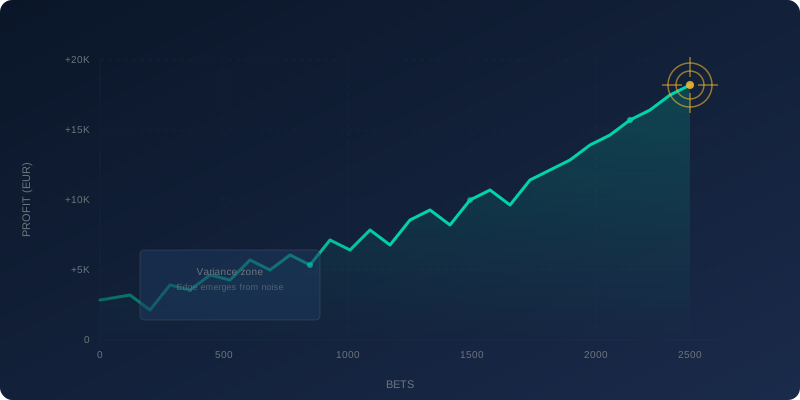
Value betting is a long-term strategy. It does not produce daily or even weekly guaranteed returns. Over any short period, luck dominates skill. A bettor with a genuine 5% edge will have losing days, losing weeks, and occasionally losing months. The edge only becomes visible and reliable over hundreds and thousands of bets.
Consider the mathematics. At a 5% edge with average odds of 2.50, your win rate is approximately 44% (slightly above the break-even rate of 40%). After 100 bets, the standard deviation of your results is large enough that you could easily be down EUR 200-500 despite having a real edge. After 500 bets, the probability of being in profit rises to approximately 85%. After 1,000 bets, it rises above 95%. After 2,000 bets, if your CLV is genuinely positive, you are virtually certain to be in profit.
This is why bankroll management is inseparable from value betting. The edge is real, but it reveals itself slowly. Your bankroll must survive the variance of the first 500-1,000 bets to reach the point where the mathematics work in your favour with high confidence. Aggressive staking (above 3% of bankroll per bet) dramatically increases the chance of ruin before the edge materialises. Conservative staking (1-2% per bet) gives the mathematics time to work.
The most successful value bettors in Ireland and elsewhere share a common trait. They are not the sharpest at finding value (though they are competent). They are the most patient. They trust the process through losing streaks, they stick to their staking rules when every instinct says to bet more, and they maintain records that prove their edge exists even when the P&L is temporarily negative. Patience, discipline, and proper bankroll management are the true competitive advantages in value betting. The value identification method is the easy part.
Why Broker Access Sustains Your Value Betting Operation
Value betting only works long-term on platforms that do not limit you. This is the fundamental constraint that separates theoretical edge from actual profit. Every successful value bettor eventually faces account restrictions from retail bookmakers. Paddy Power, BoyleSports, Betfair Sportsbook, Bet365, and William Hill all limit profitable accounts as a matter of standard practice.
Broker platforms solve this problem permanently. Through BetInAsia, AsianConnect, MadMarket, and SportMarket, you access Asian bookmakers (Pinnacle, SBO, ISN) that welcome sharp action. Pinnacle has publicly stated that they do not limit winning bettors. Their business model is built on tight margins and high volume, not on profiting from recreational losers. For a value bettor, this means your EUR 100 stakes are accepted today, next month, and next year, regardless of your results.
The exchange access provided by broker platforms (SharpXchange, OrbitX, FairExchange, PRO) serves a dual purpose for value bettors. First, it gives you the closing line data you need to calculate CLV and confirm your edge. Second, it provides a lay mechanism for the times when you want to hedge a large value bet or transition a value position into an arb. The flexibility to both back on bookmakers and lay on exchanges through a single broker account is the infrastructure that professional value bettors rely on.
Expert Tip
The single most overlooked data point in value betting is Betfair Starting Price (BSP) as a CLV benchmark for horse racing. BSP is calculated from the exchange order book at the exact moment the race starts. It is the purest available measure of the market's assessment of each horse's chance. Most value bettors track CLV against the last traded price on the exchange, which can be volatile and unrepresentative, especially on thinner Irish racing markets. BSP is more stable because it averages across the entire unmatched order book. Here is the practical application: record BSP for every horse racing value bet you place. After 300 bets, calculate your average CLV against BSP. If your average back price exceeds BSP by 5% or more, your edge on horse racing is rock solid. If it is between 2-5%, your edge exists but is thinner, and you should tighten your selection criteria. Below 2%, you are likely capturing noise rather than genuine value, and should either sharpen your angle or reduce your horse racing allocation. BSP data is freely available from the Betfair website and from data providers like BetfairData.com. Integrating it into your tracking spreadsheet takes 10 minutes per day and transforms your ability to diagnose the strength of your racing selections with mathematical precision.
Frequently Asked Questions
How many bets do I need before I can tell if I have an edge?
Sample size is the single biggest misunderstanding in value betting. At stakes of EUR 50 on average odds of 2.50, you need a minimum of 500 bets to have statistical confidence that your results are not due to luck. At 1,000 bets the picture becomes clearer, and at 2,000-3,000 bets you can be reasonably certain whether your edge is real. This is why bankroll management matters so much. You need to survive the variance of the first 500-1,000 bets without going broke. Many value bettors give up after 100 losing bets, assuming their method does not work, when in reality the sample is far too small to draw any conclusion.
What is the minimum bankroll needed for value betting?
A realistic minimum bankroll for value betting is EUR 2,000 to EUR 3,000. This allows you to stake 1-2% of bankroll per bet (EUR 20-60) while surviving the inevitable drawdowns. With a EUR 1,000 bankroll and 2% stakes (EUR 20 per bet), a typical 15-20 bet losing streak (which occurs regularly even with a genuine edge) would draw your bankroll down by EUR 300-400, or 30-40%. This level of drawdown is psychologically difficult and may force you to reduce stakes below minimum useful levels. Starting with EUR 3,000 gives you enough runway to survive variance and compound your edge over the 500+ bets needed to prove profitability.
Is value betting the same as arbitrage betting?
Value betting and arbitrage betting use the same method to identify opportunities: finding bookmaker prices that exceed the exchange market price. The difference is execution. In arbitrage, you place a back bet at the bookmaker and a lay bet on the exchange, locking in a guaranteed small profit regardless of outcome. In value betting, you only place the back bet and accept the risk that individual bets can lose. The advantage of value betting is that you capture the full edge rather than splitting it between two positions. Typical long-term ROI for value betting is 3-8% compared to 1-2% for arbitrage. The trade-off is variance. Individual value bets lose regularly, and losing streaks of 15-25 bets are normal even with a genuine edge.