
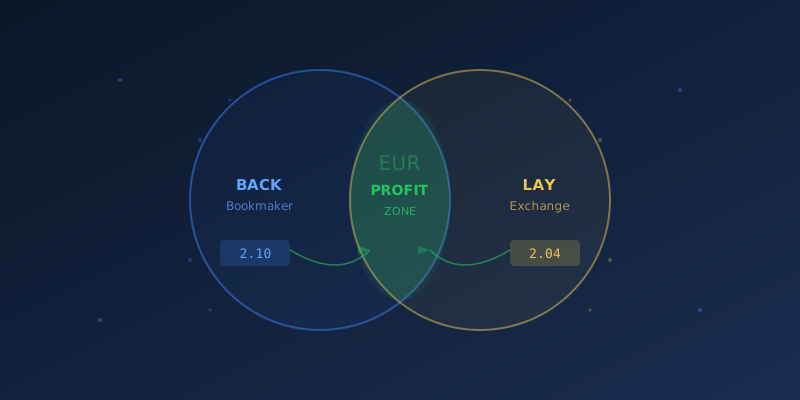
Lock In Risk-Free Profits with Exchange Arbitrage Betting
Arbitrage betting is the closest thing to a guaranteed profit in sports betting. By exploiting price differences between bookmakers and betting exchanges, you can lock in a return regardless of the outcome. The concept is simple. The execution requires discipline, speed, and the right tools. This guide covers everything an experienced bettor needs to start arbing with exchanges, including full EUR worked examples, the software that finds arbs for you, the Irish-specific opportunities most arbers miss, and the honest truth about why bookmakers will eventually limit you. More importantly, it explains why broker access is the only reliable way to sustain an arbing operation beyond a few weeks.
What Arbitrage Betting Actually Is
Arbitrage betting, also called sure betting or arbing, exploits situations where different betting operators disagree on the probability of an outcome. When a bookmaker offers higher back odds than the lay odds available on an exchange (after accounting for commission), the gap between those two prices is your guaranteed profit margin. You back the selection with the bookmaker and lay it on the exchange. If the selection wins, the bookmaker pays you more than you owe the exchange. If it loses, the exchange lay stake covers your bookmaker loss. Either way, you come out ahead.
The mathematics behind arbing are absolute. There is no opinion, no form analysis, no gut feeling. If the numbers work, the profit is locked the moment both bets are placed. This is what makes it attractive to methodical bettors who want returns without the variance that comes with traditional punting. It is also what makes bookmakers determined to shut it down, because every arb profit comes directly from their margin.
For Irish bettors, the combination of domestic bookmakers (BoyleSports, Paddy Power, Betfair Sportsbook) and exchange access through platforms like OrbitX, SharpXchange, or FairExchange creates a rich environment for finding arbs. Irish racing in particular produces frequent opportunities because domestic bookmakers are slower to adjust prices on lower-profile meetings at tracks like Thurles, Clonmel, and Wexford.
Strategy 1: Bookmaker-Exchange Arbitrage
This is the classic arb structure and the one most bettors start with. You find a bookmaker offering a back price that exceeds the exchange lay price after commission. The process has four stages: finding the arb, calculating the stakes, executing both bets, and settling.
How to Find an Arb
Arbs emerge when a bookmaker is slow to adjust a price that the exchange market has already corrected. This happens constantly - bookmakers set prices using their own models, and when they disagree with the exchange (which aggregates the opinion of thousands of bettors), a window opens. These windows last anywhere from 30 seconds to several minutes. Manual scanning is impractical. You need software, which is covered in the tools section below.
Calculating Stakes
The back stake goes on the bookmaker at the higher price. The lay stake on the exchange is calculated to equalise your profit across both outcomes. The formula for the lay stake is: Lay Stake = (Back Odds x Back Stake) / (Lay Odds - Commission Rate). Commission rate is expressed as a decimal, so 2% commission means you use (Lay Odds - 0.02 x (Lay Odds - 1)) as the effective lay odds.
Step-by-Step Execution
- Arb scanner identifies that BoyleSports is offering 3.25 on a horse in the 14:30 at Leopardstown. The exchange lay price on the same selection is 3.10 with 2% commission.
- Calculate effective lay odds: 3.10 - (0.02 x 2.10) = 3.10 - 0.042 = 3.058. Since 3.25 (back) exceeds 3.058 (effective lay), this is a confirmed arb.
- Place the back bet first: EUR 200 at 3.25 with BoyleSports. Potential return: EUR 650 (EUR 450 profit).
- Calculate lay stake: (3.25 x 200) / (3.10 - 0.042) = 650 / 3.058 = EUR 212.56. Liability: EUR 212.56 x 2.10 = EUR 446.38.
- Place the lay bet: EUR 212.56 at 3.10 on the exchange.
Worked Example: Full Settlement Calculation
If the horse wins: Bookmaker pays EUR 450 profit. Exchange lay loses EUR 446.38 liability. But you keep the lay stake commission adjustment. Net profit: EUR 450 - EUR 446.38 = EUR 3.62. After 2% exchange commission on your back winnings side: net remains EUR 3.62 because commission applies to lay profit, not losses.
If the horse loses: Bookmaker back bet loses EUR 200. Exchange lay wins EUR 212.56 minus 2% commission on winnings (EUR 212.56 x 0.02 = EUR 4.25). Lay profit: EUR 212.56 - EUR 4.25 = EUR 208.31. Net profit: EUR 208.31 - EUR 200 = EUR 8.31.
Guaranteed minimum profit: EUR 3.62 on EUR 200 staked. That is a 1.81% return. Not exciting on a single bet, but across 15 arbs per day at EUR 200, that is EUR 54 daily or approximately EUR 1,350 per month.
Risk level: Very Low. The only risks are execution failure (price moving before you place the second leg), bookmaker voiding the bet (rare but possible on obvious pricing errors), or a non-runner reducing the odds under Rule 4 deductions. Placing both legs within 10-15 seconds mitigates the first risk. Avoiding arbs above 5% margin mitigates the second, as bookmakers tend to void only extreme pricing mistakes.
Strategy 2: Exchange-to-Exchange Arbitrage
Exchange-to-exchange arbs occur when two exchanges price the same selection differently. You back on one exchange and lay on another. These are rarer and the margins are thinner than bookmaker-exchange arbs, but they carry a significant advantage: exchanges do not limit winning accounts. You can execute exchange-to-exchange arbs indefinitely without fear of account restriction.
The most common pairings for Irish and UK bettors are Betfair vs Smarkets, Betfair vs Betdaq, and Smarkets vs Betdaq. The commission structures differ across these platforms (Betfair at 5% standard, Smarkets at 2%, Betdaq at 2-5%), and these differences directly affect whether a price discrepancy constitutes a genuine arb after costs.
Through broker platforms, you can also access OrbitX, SharpXchange, and FairExchange alongside mainstream exchanges, widening the pool of potential exchange-to-exchange arbs considerably. The lower commission rates available through brokers (often 1.5-3%) make marginal arbs viable that would be unprofitable at standard retail commission.
Worked Example: Smarkets vs Betfair Arb
A Premier League match. The draw is available to back at 3.60 on Smarkets (2% commission). The draw is available to lay at 3.50 on Betfair (5% commission). Effective back return: 3.60 - (0.02 x 2.60) = 3.548. Effective lay cost: 3.50 - (0.05 x 2.50) = 3.375. Since 3.548 exceeds 3.375, this is an arb. Back EUR 150 on Smarkets at 3.60. Lay EUR 157.67 on Betfair at 3.50. If the draw lands: Smarkets pays EUR 390 (after EUR 7.80 commission = EUR 382.20). Betfair lay liability: EUR 394.18. Loss: EUR 11.98. Wait - this does not work. The margin is too thin after double commission. This illustrates the challenge with exchange-to-exchange arbs. You need at least a 0.15-0.20 tick gap to overcome double commission drag. In practice, viable exchange-to-exchange arbs require back odds at least 3-4% higher than lay odds on the opposing exchange.
Risk level: Very Low, but very low return. Realistic margins are 0.3-0.8% per arb. The main advantage is sustainability - no account limitations. If you have access to multiple exchanges through a broker account, the frequency of these arbs increases meaningfully.
Strategy 3: Value Betting as the Evolution of Arbing
Every experienced arber eventually arrives at the same conclusion: if you can identify bookmaker prices that are too high relative to exchange prices, why split the profit by hedging on the exchange? Why not just keep the back bet and let it run?
This is value betting. The concept is identical to arbing in terms of how you identify opportunities. You use exchange lay prices as the "true line" - the market's best estimate of the actual probability. When a bookmaker offers odds above this true line, the bet has positive expected value. In arbing, you lock in a small guaranteed profit by covering the other side. In value betting, you skip the lay and keep the full edge on the back bet.
The trade-off is variance. Individual value bets lose regularly. A value bet at 3.00 where the true price is 2.80 still loses roughly 64% of the time. But over hundreds of bets, the mathematical edge compounds. Studies of value betting returns consistently show 3-8% ROI over large samples, compared to 1-2% for arbing. With proper bankroll management, the higher variance is manageable and the returns are significantly better.
For Irish bettors already identifying arbs between BoyleSports or Paddy Power and the exchanges, the transition is straightforward. Instead of placing the lay leg, you simply record the bet and track your results. The same price discrepancies that signal arbs also signal value bets. The difference is that you accept short-term losses for superior long-term returns. If your arbing software shows a 2.5% arb margin, the equivalent value bet has approximately 2.5% expected value, and you capture all of it rather than splitting it across two positions.
Arb Scanning Software and Tools
Manual arb hunting is no longer viable. Prices move too fast, and the number of markets across bookmakers and exchanges is too large for human scanning. These are the four most established tools used by serious arbers in the Irish and UK market.
RebelBetting
The most popular dedicated arb scanner. RebelBetting monitors odds across 90+ bookmakers and all major exchanges in real time. It alerts you to arb opportunities, calculates optimal stakes, and shows you exactly where to place each leg. The Pro plan costs approximately EUR 180/month and covers both sure bets (arbs) and value bets. RebelBetting also includes a profit tracker and supports custom bookmaker filters, so you can focus specifically on Irish bookmakers if that is your strategy. The software refreshes odds every 5-30 seconds depending on your plan.
BetBurger
BetBurger is the most comprehensive arb scanner by coverage, monitoring over 150 bookmakers and exchanges worldwide. It excels at finding pre-match arbs and also offers a live (in-play) arb scanner, which is rarer. The premium plan runs approximately EUR 200/month for pre-match, or EUR 350/month for pre-match plus live. BetBurger is particularly strong on Asian bookmaker coverage, which matters if you are arbing through a broker that gives you access to Pinnacle, SBO, or ISN.
OddsMonkey
Best known as a matched betting tool, OddsMonkey also includes an oddsmatcher and dutching calculator that can identify arb opportunities. It is the most affordable option at approximately EUR 20-25/month, making it a sensible starting point. The trade-off is slower odds refresh rates and fewer bookmakers covered compared to RebelBetting or BetBurger. For bettors who combine arbing with matched betting (especially exploiting Irish bookmaker promotions), OddsMonkey is the most versatile single tool.
OddStorm
OddStorm positions itself as the fastest arb scanner, with odds updates as frequent as every second. The speed matters because the most profitable arbs disappear quickly. OddStorm costs approximately EUR 200/month and integrates directly with several bookmaker platforms for one-click bet placement. Its filtering system lets you set minimum margin, maximum odds, and specific sports or leagues. The speed advantage is most relevant for live arbing, where prices shift constantly during a match.
Irish-Specific Arbitrage Opportunities
Ireland offers a unique arbing environment because two major domestic bookmakers - BoyleSports and Paddy Power - are consistently slower to adjust prices on Irish horse racing than the exchange market. This creates a reliable source of arbs that bettors in other jurisdictions do not have access to.
BoyleSports in particular prices Irish National Hunt racing using internal traders who occasionally hold positions longer than the market warrants. On a busy Saturday card at Leopardstown or a midweek meeting at Navan, you will regularly find 1-3 arb opportunities where BoyleSports' morning price has not adjusted to match late money arriving on the exchanges. These arbs are typically in the 1-2% range and last 5-15 minutes before the price corrects.
Paddy Power runs frequent price boost promotions on Irish racing. These boosts sometimes push the offered price above the exchange lay price, creating artificial arbs. A standard EUR 25 price boost at 4.00 when the exchange lay is 3.70 gives you a clean arb without needing to find a natural price discrepancy. The stake limits on these boosts are low (often EUR 25-50), so the absolute profit per arb is small, but the margins can be 3-5%, which is excellent.
The challenge with Irish-bookmaker arbs is account longevity. BoyleSports monitors patterns aggressively, and consistent arbing will trigger account limits within 6-12 weeks. Paddy Power is even faster, sometimes limiting after 3-4 weeks of profitable play. This is where broker access becomes essential.
The Sustainability Problem and Why Brokers Are Essential
The single biggest challenge in arbitrage betting is not finding arbs or calculating stakes. It is keeping your accounts open. Bookmakers have sophisticated detection systems that flag arbing behaviour within weeks. The average lifespan of an arbing account at a retail bookmaker is 6-12 weeks before restrictions appear. Some bettors report limitations after as few as 10 profitable bets.
The signs are unmistakable: maximum stake reductions (from EUR 500 to EUR 5), certain markets restricted, or the blunt closure of your online account. Irish bookmakers are no exception. BoyleSports, Paddy Power, and Betfair Sportsbook all limit arbers routinely.
This is why serious arbers rely on broker access. Brokers like BetInAsia (with SharpXchange exchange access), AsianConnect (with OrbitX), MadMarket (with FairExchange), and SportMarket PRO route your bets through Asian bookmakers - principally Pinnacle, SBO, and ISN - that operate on a fundamentally different model. These books welcome sharp action. Pinnacle has never limited a bettor for winning. They profit from volume and tight margins rather than from recreational losers.
Through a single broker account, you gain access to both Asian bookmaker odds (for the back side of your arbs) and exchange platforms (for the lay side). This means you can arb indefinitely without fear of limitation. The EUR 180/month you spend on arb scanning software and the small broker commission become negligible costs against the sustained monthly income from an operation that never gets shut down.
Sustainable arbing requires broker access. Without it, you are on a treadmill - constantly opening new bookmaker accounts, using friends and family members, and eventually running out of options. With broker access, you are running a genuine long-term operation that scales with your bankroll.
Realistic Expectations for Arbitrage Returns
Typical arb margins range from 0.5% to 3%. Anything above 3% should be treated with caution, as it may indicate a pricing error that the bookmaker will void, or a market with very low liquidity on the exchange side where your lay bet may not get matched at the quoted price.
Volume matters far more than margin. An arber who executes 20 bets per day at 1% average margin with EUR 250 stakes generates EUR 50 daily, or roughly EUR 1,250 per month. Increasing to 30 bets per day or raising stakes to EUR 400 scales the returns proportionally. The constraint is usually available arbs in your geographic market and the speed at which you can execute both legs.
Expect some losing days. Execution slippage (prices moving between placing the back and lay legs), Rule 4 deductions on non-runners in horse racing, and occasional void bets will eat into your margins. A realistic monthly return after accounting for these frictions is 60-70% of your theoretical gross arb profit. On a EUR 5,000 bankroll turning over EUR 5,000-8,000 per day across multiple arbs, a net monthly profit of EUR 800-1,500 is achievable for a committed arber with the right tools and access.
Expert Tip
The crossover between arbing and value betting is where the real money lives. Use exchange lay prices as your "true line" for any event. When a bookmaker offers odds 3% or more above the exchange price, you have found an arb. But here is the insight most arbers miss: that same 3% gap tells you the bookmaker is offering positive expected value. Instead of laying on the exchange to lock in a small guaranteed profit, consider taking the back bet without hedging on your strongest signals - the ones where your own analysis agrees with the exchange price. Over a month, a portfolio of 100 value bets at 3% expected value delivers far more than 100 arbs at 1.5% locked margin. The transition from arbing to value betting is not abandoning one strategy for another. It is using the arbing framework to identify value, then choosing when to hedge and when to let the edge run. Start by splitting your bankroll: 70% for pure arbs, 30% for unhedged value bets where the margin exceeds 2.5%. Track both separately. After three months, the data will speak for itself.
Frequently Asked Questions
How much money do I need to start arbitrage betting?
A working bankroll of EUR 2,000 to EUR 5,000 is a realistic starting point for exchange arbitrage. Since typical arb margins are 0.5-3%, you need volume to generate meaningful returns. With EUR 3,000 and 10 arbs per day averaging 1.5% margin at EUR 200 per arb, your daily profit is roughly EUR 30. Below EUR 1,000 the returns are too small to justify the time investment, and you will struggle to cover both the back stake and the exchange lay liability simultaneously.
Is arbitrage betting legal in Ireland?
Yes, arbitrage betting is entirely legal in Ireland and across Europe. You are simply placing bets at different prices with different operators, which is your right as a consumer. However, bookmakers reserve the right to limit or close accounts of bettors they suspect of arbing. This is not a legal restriction but a commercial decision. Irish-licensed bookmakers like BoyleSports and Paddy Power are particularly aggressive about account restrictions, which is why broker access to Asian books that do not limit is essential for long-term arbing.
What is the difference between arbitrage betting and value betting?
Arbitrage betting guarantees a profit on every individual bet by covering all outcomes at prices that create a mathematical margin. Value betting identifies bets where the bookmaker price exceeds the true probability (as estimated by exchange prices or models) but does not hedge the other side. Value betting produces higher long-term returns because you capture the full edge rather than splitting it across two positions, but individual bets can lose. Many experienced arbers transition to value betting once they understand how to identify mispriced odds using exchange data as their benchmark.